
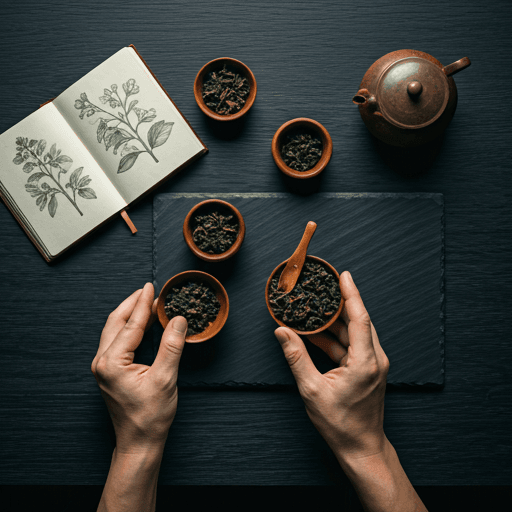
Ninghong black tea is a bright, orchid-sweet red tea from the misty mountains of Xiushui in Jiangxi province, and it carries one of the longer pedigrees in the Chinese black-tea family. Frequently described as among the earliest gongfu-style black teas and a Qing-dynasty tribute tea, it pours a luminous red liquor rimmed with gold and finishes long, smooth, and honeyed. This guide walks through where Ninghong comes from, how it is made, what it tastes like, and how it stands apart from its more famous cousins.
What is ninghong black tea?
Ninghong black tea (宁红, roughly "Ning red") is a fully oxidized Chinese black tea — what Chinese tradition calls a "red tea" (hong cha) for the color of its brewed liquor rather than its dry leaf. The name joins Ning, from the old Ningzhou or Ning prefecture that once governed the growing area, with hong, "red." Made in the gongfu (also spelled congou) style, it is prized for a sweet, floral, orchid-like aroma and a clear, glowing red cup.
It belongs to the same broad category as every other black tea, but its regional character is what sets it apart. If you are new to the type, our overview of what black tea is explains how full oxidation turns green leaf into the dark, malty, or fruity styles found across China and beyond. Within that world, ninghong black tea sits among the classic Chinese gongfu blacks, in the same conversation as names like Keemun and Dian Hong.
Where ninghong black tea comes from
Ninghong is grown in and around Xiushui County in the northwestern corner of Jiangxi province, a hilly inland region where Jiangxi meets the provinces of Hubei and Hunan. Historically this area fell under Ningzhou, or Ning prefecture, and the "Ning" in the tea's name preserves that old administrative label. Tea has reportedly been cultivated in the county for many centuries — some accounts trace leaf-growing here back to the Tang era — though the specific black tea we now call Ninghong is a much later development.
The land and climate
The growing zone is mountainous, with limited flat farmland, deep and fertile soil, plentiful rainfall, and a mild, humid subtropical climate. Mist clings to the slopes for much of the year, diffusing sunlight and slowing leaf growth — conditions tea makers across China associate with sweeter, more aromatic leaf. Those chemical riches in the fresh leaf are part of why the finished tea can carry such a full, honeyed flavor.
A short history: tribute tea and the export era
Black tea production in the Xiushui area is commonly dated to the Daoguang period of the Qing dynasty, around the 1820s, with some accounts tracing local roots back further into the late eighteenth century. That makes Ninghong one of the older names in Chinese black tea, and it is often said to be among the earliest gongfu-style black teas — predating the rise of Keemun in neighboring Anhui by a matter of decades. As with many "oldest tea" claims, the precise firsts are contested, so it is safest to describe Ninghong as being among the early gongfu blacks rather than definitively the first.
Ninghong's real fame came during the export era of the late nineteenth century. It is commonly recounted that between about 1892 and 1894, in the Guangxu reign, the tea reached its commercial peak, shipping in large volumes to overseas markets, and that in 1904 it was formally listed as a tribute tea for the Qing court. Another oft-repeated story holds that a visiting Russian dignitary presented a laudatory plaque praising the tea's quality. These accounts appear throughout tea literature; the broad outline is well established, but it is wise to treat the finer details as tradition rather than firmly documented fact.
The "Prince's Tea" lore
Some of the most prized old grades are wrapped in the label Taizi Cha (太子茶), or "Prince's Tea," a name tied to Ninghong's tribute status and its reputation at the imperial court. Whether every retelling is literal history or embroidered legend, the nickname captures how highly this Jiangxi red was once regarded — and it is a large part of why ninghong black tea earned a place in the tribute record at all. Today the traditional making skills of Ninghong are recognized as part of China's national intangible cultural heritage, folded into the wider body of Chinese tea-processing traditions.
How ninghong black tea is made
Ninghong is produced in the labor-intensive gongfu black-tea style, in which the maker coaxes slender, even, tippy leaves through a series of careful, hand-guided steps. The core sequence is familiar to anyone who knows Chinese black tea, but the attention to leaf shape and grading is exactly what earns the "gongfu" (skillful effort) name. A traditional description of the local method emphasizes light withering, heavy rolling, and thorough oxidation.
- Plucking: the best grades are picked in early spring, around the Qingming festival, often to a fine standard of one bud with one just-opened leaf.
- Withering: fresh leaf is spread and softened, shedding moisture so it can be rolled without shattering.
- Rolling: the leaf is rolled to twist it into tight strands and rupture the cell walls, releasing juices and enzymes.
- Oxidation: the rolled leaf is left to fully oxidize — the step Chinese tradition calls "fermentation" — developing the dark color and sweet, fruity aroma.
- Drying, refining, and sieving: the tea is fired dry, then sorted and sieved into grades, with the golden-tipped strands separated out for the higher tiers.
What ninghong black tea tastes like
In the cup, ninghong black tea is best known for a sweet, mellow character and a distinctly floral, orchid-like fragrance, often layered with notes of honey, caramel, and ripe fruit. The liquor is a clear, bright red, and many premium lots throw a visible "golden ring" around the inside of the cup — a traditional marker of quality. It tends to be smooth and brisk rather than aggressively bold, which makes it approachable on its own without milk or sweetener.
| Attribute | Ninghong gongfu black tea |
|---|---|
| Origin | Xiushui County, Jiangxi province, China |
| Type | Fully oxidized black ("red") tea, gongfu style |
| Dry leaf | Tight, slender strands, dark with golden tips in top grades |
| Liquor | Bright, clear red, often with a golden rim |
| Aroma | Orchid-like, floral, sweet |
| Flavor | Honey, caramel, ripe fruit; smooth and mellow |
| Best picked | Early spring, around the Qingming festival |
Grades: Ninghong gongfu and golden tips
Most Ninghong is labeled simply as Ninghong Gongfu, but the range climbs from everyday leaf up to showy, tip-heavy grades. The top tier, sometimes marked with words like jinhao ("golden tips"), is made from tender early buds and shows a high proportion of downy, golden strands; these tend to be the sweetest and most fragrant. As a rule of thumb, the more golden tips a batch carries and the tighter and more uniform its leaf, the more delicate and honeyed the resulting brew. Because it is a spring-picked, tippy black tea, Ninghong is best enjoyed reasonably fresh — keep it cool, dry, sealed, and away from light and strong odors to protect its aroma.
How to brew ninghong black tea
Ninghong is forgiving, and you can brew it Western style in a mug or teapot, or gongfu style in a small vessel for successive short steeps. A few starting points:
- Water: use fresh, just-off-the-boil water, roughly 90–95°C (about 194–203°F). Very tippy grades can take slightly cooler water to keep them sweet.
- Western style: about 3 grams of leaf per 200–250 ml, steeped 2–3 minutes, then extended on later infusions to taste.
- Gongfu style: a heavier leaf-to-water ratio in a small gaiwan with brief steeps of 10–20 seconds, adding a little time each round; good leaf will give several fragrant infusions.
- Serving: a white porcelain cup shows off the red liquor and golden ring. Ninghong is sweet enough to enjoy plain, though it can take a splash of milk if you prefer.
Ninghong black tea vs. its famous siblings
Ninghong is often grouped with China's other celebrated gongfu blacks, and it helps to taste it against them. It is distinct from the Fujian gongfu reds and from Keemun, which comes from Qimen County in the neighboring province of Anhui. For a broader tour of the country's styles, our guide to Chinese tea sets the scene, while our guides to Keemun and Dian Hong go deeper on two of Ninghong's closest peers.
| Tea | Origin | Signature character |
|---|---|---|
| Ninghong | Xiushui, Jiangxi | Orchid-sweet and honeyed, with a bright red liquor |
| Keemun (Qimen) | Qimen, Anhui | The famous "Keemun aroma" — floral, cocoa, faintly wine-like |
| Dian Hong | Yunnan | Bolder and maltier, often very tippy and honey-sweet |
Because they are near neighbors, Ninghong and Keemun can read as cousins, both leaning floral and sweet rather than heavy. Dian Hong, from farther southwest, is usually bolder and maltier by comparison. Tasting the three side by side is one of the best ways to appreciate what regional terroir does to a single category of tea.
A note on caffeine and wellness
As a black tea, Ninghong contains caffeine. A typical cup is often cited around 40–60 mg, but the real figure varies widely with leaf grade, how much you use, water temperature, and steeping time, so treat any number as an approximation. Like other true teas, it also supplies plant compounds such as polyphenols that are the subject of ongoing research; any benefits people associate with tea are best described with measured "may" language rather than firm promises. This is general information, not medical advice — if you are managing caffeine intake or a health condition, it is sensible to check with a qualified professional.
Elegant, historic, and a little under-the-radar outside China, Ninghong rewards a slow cup. Whether you approach it as a piece of Qing-dynasty tea history or simply as a fragrant, orchid-sweet red for the afternoon, it remains one of the more quietly rewarding names in the Chinese black-tea canon.