
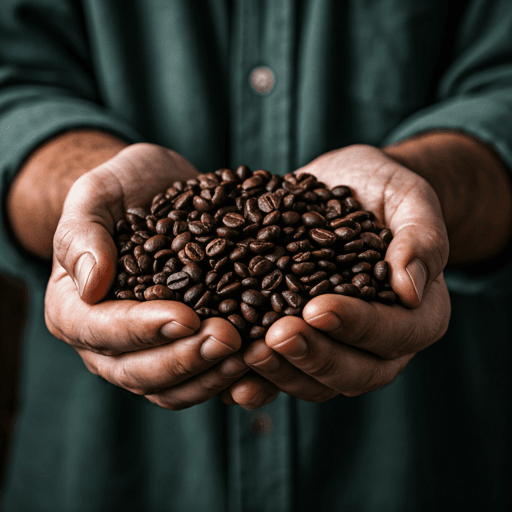
Maldives coffee does not exist as a crop. No coffee is grown commercially anywhere in the archipelago, and every bean poured in a Male cafe or on a resort island arrived by ship or plane. The reason is not the climate and not the economics. It is the physical absence of ground to plant a tree in.
That is a genuinely different explanation from the one that usually accounts for a missing origin. Normally the argument is about what the land is like: too dry, too cold, too high, too temperate, the wrong latitude or the wrong soil chemistry. The Maldives inverts the question. It is tropical. It is warm all year. It gets monsoon rain. What it does not have is land - not land of poor quality, but land as a quantity.
Maldives Coffee Fails on Area, Not on Weather
Picture the country the way a map actually shows it: a very large area of ocean containing a very small area of low coral island, strung out in atoll rings and split into many separate fragments, most of them small, flat and narrow. The dry surface is not one growing region with internal variety - no highland shoulder, no valley floor, no leeward slope. It is a scatter of disconnected patches, every one of them bounded by beach on all sides, and it is among the most dispersed inhabited territory anywhere.
Climate alone would not settle the matter. A sea-level equatorial site is hot for arabica, which does its best work in cooler air at altitude, but robusta-type coffee is grown near sea level in hot, humid places elsewhere in the tropics, so on temperature and rainfall a Maldivian island is not obviously disqualified. Light is not the problem either. The binding constraint sits underneath the plant, not above it.
What a Coffee Tree Actually Asks For
In Ethiopia or Colombia or Sumatra these requirements are simply met and nobody has to itemize them. Set against a coral island, they become very visible:
- Depth. Coffee is a woody perennial that sends roots down, and it wants a deep, friable, mildly acidic soil with organic matter in it. Coral sand is the opposite on almost every count.
- Time. A planting occupies its ground for years before a first real harvest, and for years more before it justifies the space. Annual vegetables can be pulled out and replaced within a season; a coffee block commits scarce area for the better part of a decade.
- Contiguity. Coffee is picked selectively and processed quickly, which means a picking crew, a pulper or a drying surface, and enough trees close together to be worth organizing. Scattered handfuls of trees on separate islands do not add up to that.
- Fresh water in the dry months. Coffee is evergreen and transpires all year. It cannot ride out a hard seasonal cut in moisture the way a crop that drops its leaves can, and it cannot be left unwatered between harvests.
- Shelter from salt. Coffee is not a salt-tolerant plant. On a narrow island, salt-laden wind crosses the entire width of the land, and there is no interior to retreat into.
At a Glance: What Coffee Needs Versus What a Coral Island Offers
| Coffee needs | What a Maldivian island has | Result |
|---|---|---|
| Deep, root-penetrable soil | Thin coral sand, described in agricultural assessments as coarse, porous and resistant to root penetration | No rooting volume for a long-lived tree |
| Mildly acidic, nutrient-holding soil | Strongly alkaline sand, reported as low in organic matter and deficient in nitrogen and potassium, and poor at holding either | Chronic deficiency without constant inputs |
| Reliable fresh water year-round | No rivers, lakes or streams; rainwater plus a thin freshwater lens under each island, and desalination for much of the piped supply | Irrigation competes directly with drinking water |
| A contiguous block of ground | Many separate small islands, each with a shoreline on every side | No field large enough for a crew or a mill |
| Low salt exposure | Salt spray across the full width of narrow islands, and seawater intrusion into soil and groundwater | Leaf and root stress on a salt-sensitive species |
| Uncontested area at scale | Land already committed to housing, tourism, food gardening, coconut and breadfruit | Coffee never wins the square metre |
Soil, Water and Fragmentation: The Three Real Locks
Take them in order, because each one alone would be a serious handicap and together they close the question.
Soil. Agricultural assessments of the country describe its soils in consistently discouraging terms: coarse and porous, strongly alkaline, low in organic matter, short of nitrogen and potassium, and physically resistant to root penetration. That is a fair description of what coral sand is - mineral fragments of reef, with a thin organic skin wherever vegetation has managed to build one. The plants that thrive there without help are the salt-tolerant shrubs, screwpine and coconut palms that give the islands their look, and the productive tradition that grew up around them is agroforestry: coconut overhead, with breadfruit, banana, taro, chilies and root crops beneath. Those are not arbitrary choices. Atoll farming has always meant working with whatever tolerates alkaline sand, brackish groundwater and shallow rooting, and those crops had generations to prove that they do. A coffee tree asks for the reverse of all three conditions at once.
Fresh water. There are no rivers, lakes or streams. Each inhabited island sits over a lens-shaped body of fresh groundwater floating on denser seawater, recharged only by rain that soaks through the sand. That lens is thin, and it is easy to damage from either direction: pump it too hard and salt water is drawn up into it from below, and storm overwash can spoil it from above. Elevated salinity in island groundwater is widely reported, which is a large part of why so much of the drinking supply is now rainwater catchment or desalinated seawater rather than wells. This is where coffee's evergreen habit turns from awkward into disqualifying. A crop that must be watered through every dry stretch, for years on end, would be drawing on the same lens the community drinks from, or on desalinated water that was produced for people. No agronomy resolves that trade.
Fragmentation. This is the constraint outsiders underestimate most. Even if you could sum the country's usable soil into one imaginary field, it does not exist as one field. It exists as many small pieces separated by open water, and that changes everything about how a crop can be worked. Labor cannot be surged to a harvest peak easily, equipment cannot be shared between neighbors, and a mill on one island cannot serve trees on another without a boat schedule that farming can rely on. Assessments of the sector name exactly this - scarcity of land, uneven distribution of the land that is suitable, and the absence of dependable inter-island transport - as a core obstacle for the produce that is grown. Coffee, which must be pulped or spread to dry within hours of picking, is close to the worst possible crop to spread across an archipelago.
What a Maldivian Coffee Plot Would Actually Involve
Work it through concretely. You clear a patch of an island that is not already houses, guest rooms, vegetable beds or coconut. You import or manufacture soil, because the native sand will not hold a tree, and you keep importing organic matter, because rain flushes nutrients straight through porous sand into the lens. You commit that patch for years with nothing coming off it, irrigating through every dry spell with water that has a higher use. Then the cherry ripens unevenly, as coffee cherry does, so you need repeat passes by pickers over several weeks, on an island whose whole labor pool is small and already employed. Whatever comes off the trees has to be pulped or laid out to dry the same day, so the processing equipment must live on that island, for that one small planting. Repeat the exercise on a second island and none of it gets simpler. Every step a normal origin solves with contiguous area, depth of soil and a rural workforce has to be solved here from scratch, one island at a time.
One plain fact belongs alongside all of this: these are low-lying coral islands, so exposure to the sea and to storm overwash is a permanent feature of any land-use thinking there, which does nothing to make a decade-long tree planting more attractive.
A Coffee Market, Not a Coffee Origin
None of this makes coffee marginal in the Maldives. The opposite is true. The country handles and serves coffee at a standard well above what its agricultural situation would suggest, entirely on imported beans, and coffee there is a story about handling rather than growing.
Accounts of the scene are largely journalistic rather than statistical, so the sequence is clearer than the dating. They tell a reasonably consistent story: tea was the dominant hot drink for most of the twentieth century, instant and then espresso-style coffee arrived later, and sit-down cafe culture in Male is described as taking off once air-conditioned rooms turned coffee from a functional drink into a social occasion. Specialty coffee followed, and it is reported that companies based in the country began importing green coffee and roasting it locally rather than buying finished roasted product from abroad. Barista training and coffee-grading qualifications are reported to be available in-country as well.
So the local craft is real; it simply sits downstream of the farm. Roasting, blending to a cafe's or a resort's specification, dialing in espresso in high humidity, keeping green coffee stable in a hot marine climate, training staff - and one specific quirk of the place, building the brewing water. Much of the drinking supply is desalinated, and desalinated water is close to mineral-free, so anyone extracting coffee from it has to put minerals back or accept a flat, hollow cup. That is a problem a roaster working from a mineral-rich municipal supply rarely has to think about.
It is worth being blunt about the distinction, because "coffee country" gets used loosely. An origin is a place where agricultural decisions are made: variety, shade, picking, processing, drying. A market is a place where the cup is bought and drunk. The Maldives is emphatically the second and not at all the first, and one does not imply the other. This page does not compile demand figures; for how consumption is shifting in import-fed markets, see our guide to global coffee consumption trends.
The Drink That Was Already There
Coffee arrived into an existing hot-drink habit rather than an empty slot. Maldivian tea culture - sai - is commonly described in local food writing as strong black tea, usually sweetened, either plain (kalhu sai) or with milk (kiru sai), sometimes with cardamom or cinnamon, drawing on the tea traditions of the wider South Asian region. Transliterations vary, so the spellings are best read as approximate. It is drunk through the day and especially in the late afternoon, and it is inseparable from hedhikaa, the plates of short eats served alongside it; the pairing of hot tea with those snacks is one of the few parts of the record that is documented consistently. Teashops are where that happens socially.
Coffee did not displace any of that; the two now sit side by side, serving overlapping but distinct occasions. The contrast with Mauritania is instructive, because there the absence is double - no crop and no coffee ritual either, since strong green tea has held the hospitality role for generations. In the Maldives only the supply side is missing. Demand is large, sophisticated and growing.
How the Maldives Compares With Other Almost-Zero Origins
Other near-zero cases fail for different reasons, and the differences sharpen what is happening here.
- Seychelles is the closest comparison and the most useful contrast: another Indian Ocean island nation with a negligible coffee presence, except that there a tiny planting genuinely does exist, because granitic islands have hills, slope and real soil depth. The Seychelles have the ground and lack the incentive; the Maldives lacks the ground.
- French Guiana sits well inside the coffee belt on a continental landmass with no shortage of space, and grows effectively none because nothing in the way its economy works rewards building an export crop.
- Landless but thirsty is the Maldivian signature: strong consumption, zero cultivation, and no plausible route from one to the other. It is the extreme end of island agriculture, where the question is not which crop to choose but whether there is anywhere at all to put one.
Could Anything Change?
The honest answer is no, and the reasons are worth stating, because the technology usually invoked here does not do what people assume.
Controlled-environment growing is genuinely expanding in the country. Resorts have built hydroponic greenhouses, community projects backed by development agencies have set up solar-powered growing units, and hydroponics is widely promoted there precisely as a way around the soil. But look at what those systems produce: leafy greens, herbs, tomatoes, chilies - fast-cycling plants, harvested continuously, replaced within weeks. That is the right use of an intensively managed square metre on an island where the square metre is the scarce input.
A coffee tree is the wrong crop for that space by every measure. It would hold its position for years before yielding anything, fruit once or twice a year, and give up a small quantity of cherry whose usable product only appears after pulping, drying and roasting. Salad beats it on every axis a greenhouse cares about. Nor does altitude come to the rescue: without elevation there is no cool, slow ripening period to make the result distinctive, so even a technically successful harvest would have no particular reason to be sought out.
Could a few trees exist somewhere - in a resort garden, a botanical planting, a pot behind a cafe? Possibly, and the public record is thin either way. But a handful of ornamental trees is a curiosity, not an emerging industry. There is no documented commercial planting, no harvest, no variety roster and no verified cup profile, and anything presented as one is describing something that does not exist.
The Bottom Line
The Maldives is the clearest case anywhere of coffee failing on geometry rather than on climate. There is warmth, there is rain, there is demand, there is skill - and there is no block of deep, fresh-watered, uncontested ground in the country to commit to a tree for a decade. What the archipelago has instead is a serious import-fed coffee culture in which the interesting work happens between the shipping container and the cup. Judge Maldivian coffee as roasting and service and it stands up well. Judge it as agriculture and there is nothing to judge - which is the accurate answer, not an evasion.