
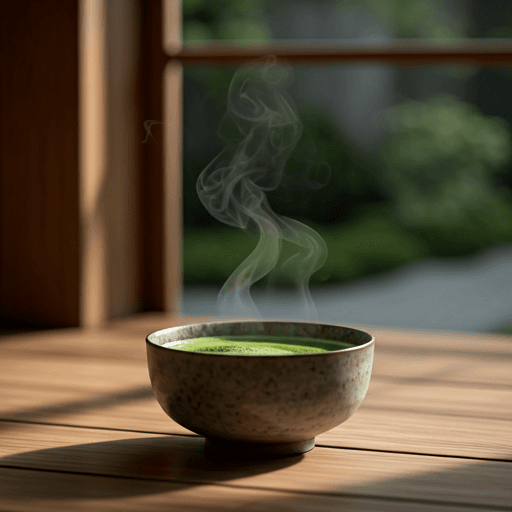
Walk up to the hot-water tap at a conveyor-belt sushi counter, spoon a little green powder into your cup, top it with water, and you have just made a cup of funmatsucha. Funmatsucha (粉末茶) is the Japanese term for "powdered tea" — an everyday green tea reduced to a fine powder so it can go straight into hot or cold water with no steeping, no teapot, and no leaves to strain out. It is the quiet workhorse behind self-serve sushi-bar tea, bottled ready-to-drink green tea, and countless recipes. And it is constantly mistaken for its far more famous cousin, matcha, even though the two are made, priced, and behave in completely different ways.
What is funmatsucha powdered green tea?
Funmatsucha powdered green tea is a format rather than a single cultivar or growing region. Ordinary Japanese green tea — most often sencha, but also hōjicha (roasted green tea), gyokuro, or genmaicha — is turned into a powder that you can prepare instantly. The whole point is convenience: instead of measuring leaf, warming a pot, timing a steep, and discarding the leaves, you simply stir a spoonful into a cup. Because there is nothing to throw away, you also take in the entire leaf, including fibre and compounds that a normal steep leaves behind in the spent leaves. It is one of many forms green tea can take, and it sits at the practical, everyday end of the spectrum.
Under the single word "funmatsucha" there are really two industrial realities. The most water-soluble kind is a true instant tea: brewed green-tea liquor is concentrated and spray-dried into a powder that dissolves completely, leaving a clear cup with no sediment. A simpler style is made by pulverizing dried sencha leaf into a fine powder; because that is still whole leaf, it disperses through the water and is drunk in full, and a little sediment resting at the bottom of the cup is normal. Both are sold as "powdered green tea," and both trade the ritual of brewing for speed.
Funmatsucha vs. matcha: the essential contrast
To the eye, a jar of funmatsucha and a tin of matcha can look almost identical — both are simply green powders. In practice they sit at opposite ends of the Japanese tea world. The clearest way to separate them is to ask what happens when the powder meets water.
| Aspect | Funmatsucha (powdered / instant tea) | Matcha |
|---|---|---|
| Base leaf | Ordinary green tea (sencha, hōjicha, genmaicha), usually unshaded | Tencha — shade-grown for weeks before harvest |
| Processing | Leaf pulverized in industrial mills, or brewed tea spray-dried into an instant powder | Steamed, de-veined tencha slowly stone-ground on granite mills |
| Particle size | Coarser, often cited around 40–80 microns | Ultra-fine, often cited around 1–10 microns |
| In water | Instant type dissolves fully with no sediment; pulverized type disperses and is drunk whole | Never truly dissolves; whisked into a suspension |
| How you prepare it | Stir with a spoon, hot or cold | Whisk with a bamboo chasen |
| Typical role | Everyday, instant, industrial, cooking | Ceremonial, culinary, premium drinks |
| Flavor | Concentrated, brisk, often astringent | Rounder, sweeter, more umami when well made |
Why matcha stays suspended and instant funmatsucha dissolves
Matcha is made from tencha, a shade-grown leaf that is steamed, dried without rolling, stripped of stems and veins, and then stone-ground on slow granite mills into an ultra-fine powder. Those particles are intact leaf solids: they never truly dissolve. Whisk matcha and you create a suspension — a cloud of ground leaf held in the water — which is why it needs a bamboo whisk (chasen), why it foams, and why it settles if you let the bowl sit. You are, quite literally, drinking the leaf.
Instant funmatsucha is a different thing entirely. Spray-dried instant tea is not leaf at all; it is dried tea extract, so it goes fully into solution the way instant coffee does, dissolving cleanly with a quick stir. Even the pulverized-leaf style of funmatsucha, though technically a fine suspension like matcha, is ground from cheaper, unshaded leaf at a coarser size, so it is designed for a fast stir rather than a ceremonial whisk. The shorthand many tea sellers use is apt: matcha is a suspension you whisk and drink, while funmatsucha is the "instant coffee" of green tea.
How funmatsucha is made
Two production routes account for most funmatsucha. In the pulverizing route, finished green tea — usually a workaday sencha, sometimes hōjicha or genmaicha — is milled into a fine powder using industrial grinders rather than the slow stone mills reserved for matcha. Because ordinary, unshaded leaf is used and the grind need not be as fine, it is far simpler and quicker to produce than matcha. In the instant route, tea is first brewed, the liquor is concentrated, and it is spray-dried (or freeze-dried) into a soluble powder; small amounts of dextrin or other carriers are sometimes added so the powder flows and dissolves cleanly, which is why some instant teas list ingredients beyond tea itself.
Whichever route is used, powder has one drawback: surface area. Ground tea is exposed to air, light, and moisture far more than whole leaf, so funmatsucha stales relatively quickly. Keep it sealed, cool, and away from light, and use it within a few weeks of opening for the brightest color and flavor. Much of Japan's everyday green tea leaf comes from major producing areas such as Shizuoka, and that same ordinary sencha is exactly the kind of leaf that becomes funmatsucha.
Funmatsucha vs. konacha: the sushi-bar "dust"
Funmatsucha is also easy to confuse with konacha, another inexpensive green tea tied to sushi counters — but they are not the same. Konacha (粉茶, literally "powder tea," though the name is a little misleading) is not a soluble powder at all. It is made of the small broken leaf fragments, buds, and fannings sifted out during the production of sencha and gyokuro. Those bits are real leaf: you brew konacha in a pot or through a strainer, it steeps in seconds into a deep-green, brisk, full-bodied cup, and you discard the spent fragments afterward.
That brewed konacha is the tea traditionally served at sushi restaurants, where it is known as "agari." Its bracing, slightly bitter character cuts through rich fish and refreshes the palate between pieces. The powdered tea you self-serve at a modern conveyor-belt (kaiten-zushi) counter, by contrast, is usually a funmatsucha — a stir-and-drink powder set beside a hot-water tap, adopted partly to cut down on tea-bag waste. So both can appear at the sushi bar, but konacha is leaf you brew and strain, while funmatsucha is powder you stir straight into the cup.
Where you will actually meet funmatsucha
Once you know what to look for, funmatsucha turns up throughout Japanese food and drink:
- Sushi-bar "agari": the self-serve powder-and-hot-water-tap setup at conveyor-belt sushi is classic funmatsucha territory.
- The bottled-tea industry: because the instant, spray-dried type dissolves with perfect clarity and no sediment, it is a mainstay of ready-to-drink bottled green teas, vending-machine drinks, and factory blends where consistency matters.
- Cooking and baking: a spoonful colors and flavors ice cream, sweets, soba noodles, lattes, and smoothies, or is mixed with salt to make a green-tea seasoning. Cooks often reach for funmatsucha instead of pricier matcha when the dish does not need ceremonial quality.
- Everyday convenience cups: at the office, while traveling, or over ice, funmatsucha delivers a cup of green tea in seconds — hot or cold, with nothing to strain.
Flavor, caffeine, and what to expect in the cup
Flavor depends on the base tea. Funmatsucha made from sencha tastes like a concentrated sencha: brisk, grassy, and often noticeably more astringent and bitter than matcha, because the leaf is not shade-grown and you are consuming it at full strength. Versions built on hōjicha are toasty and mellow, while genmaicha-based powders carry a nutty, popcorn-like note. None of them offer the rounded, umami sweetness that careful shading gives good matcha — funmatsucha is made for convenience and value, not for the ceremony.
As a green tea, funmatsucha contains caffeine. A serving's caffeine is often cited somewhere around 20–45 mg per 8-ounce cup, but this varies widely with the base leaf, how much powder you use, and water temperature; because you drink the whole leaf in the pulverized style, a strong scoop can deliver more than a light steep would. Green tea also supplies antioxidant compounds such as catechins. This is general information, not medical advice — if you are managing caffeine intake or have specific health concerns, check with a qualified professional.
How to use funmatsucha at home
Preparing funmatsucha could hardly be simpler. For a hot cup, stir roughly half a teaspoon to a teaspoon into about 150 ml of hot (not boiling) water; cooler water, around 70–80°C, keeps a sencha-based powder from turning harsh. For iced tea, the instant type dissolves readily in cold water, making it ideal for a fast summer drink, while a pulverized-leaf powder will disperse with a good stir or shake and may leave a little sediment. Beyond the cup, treat it like any culinary powder: whisk it into batters, fold it into cream, or blend it into a smoothie. When you want the ceremony and the umami, reach for whisked matcha; when you just want green tea, fast, funmatsucha is hard to beat. To place it in context, it helps to understand the wider world of tea types, and you can browse more guides across our tea collection.