
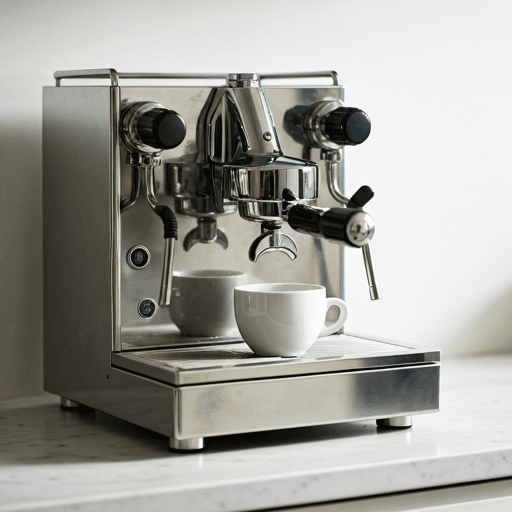
A compact coffee machine is simply a coffee maker chosen for its small footprint: it gives you a good cup without taking over the counter. Which one is right for you depends less on the brand on the box and more on the type you pick and the space you actually have. This guide maps the compact-friendly machine types, weighs their trade-offs, and shows exactly how to measure your kitchen before you choose a small-footprint maker for an apartment, dorm, RV, tiny office or any crowded counter.
What counts as a compact coffee machine
"Compact" is about three dimensions, not one. Width is the obvious one, but the deal-breaker is often height: many counters sit under a wall cabinet, and a machine you cannot open to refill water or drop in a pod is no use, however narrow it looks. Depth matters too, because a deep body pushes the machine forward into your working space. So a genuinely space-saving coffee maker is one that fits all three ways at once, and ideally lets you lift its lid or pull its tank with the cabinet still above it.
The other half of "compact" is what you give up to get small. Smaller almost always means a smaller water reservoir, fewer cups per fill, and often a narrower feature set. None of that is a problem if it matches how you drink. A solo flat-white drinker and a four-mug household need very different machines, and the smallest unit that covers your real routine is the right one. This is the same honest-habits question we walk through in how to choose a coffee maker, narrowed here to the single goal of saving space.
The compact-friendly machine types
Several whole categories suit a tight counter. Each gets small in a different way, and each trades something different for it. Here is how the main compact coffee maker styles compare in plain terms.
Slim pod and capsule machines
Pod machines are usually the smallest electric option. Because the coffee arrives sealed in a capsule, the machine itself needs only a pump, a heater and a small tank, so the body can be remarkably narrow. Some single-serve pod machines are barely wider than a mug; the Nespresso Essenza Mini, for example, is around 3 inches wide, and certain mini Keurig models skip a fixed reservoir entirely and let you pour fresh water in per cup. That plug-and-play simplicity is the appeal: no grinding, no mess, a cup in under a minute. The trade-offs are an ongoing per-pod cost, more packaging waste, and a flavour ceiling set by what is sealed inside the capsule rather than by fresh grinding.
Single-serve and small drip makers
If you want filter-style coffee from a small coffee machine, look at single-serve brewers that drip straight into a travel mug, or small drip makers that brew roughly one to five cups instead of a full ten- or twelve-cup pot. The compact drip makers shrink the carafe and reservoir rather than the brewing method, so you still get familiar, gentle filter coffee. They suit one or two people who drink a mug or two and never need a big batch. If filter coffee is your daily driver, our drip coffee maker guide covers the wider category, of which these small models are the space-saving slice.
Compact and slim espresso machines
You do not need a wide, cafe-style machine to pull real espresso at home. A number of single-boiler, semi-automatic espresso machines are built deliberately narrow, sometimes only around 7 to 8 inches wide, so they slot beside a toaster or microwave. They still have a portafilter and usually a steam wand, so the workflow and the results are genuine espresso, not a pod imitation. The catch is that a slim espresso machine often pairs with a separate grinder, which adds its own footprint, and the steaming-then-brewing routine asks a little more of you. For the technique itself, see how to make espresso at home.
Small bean-to-cup machines
Bean-to-cup machines grind, brew and often froth at one button press, and a few are built in slim, tall bodies aimed squarely at tight kitchens. They are the most hands-off way to get fresh-ground, espresso-based drinks in a small space, but "compact" is relative here: even a slim model is taller and deeper than a pod machine because it has to hide a grinder, a brew unit and a bean hopper inside. Measure the height with the bean-lid open. If a one-touch cappuccino with no skill required is the goal, weigh these against the alternatives in our bean-to-cup coffee machine guide.
Non-electric compact brewers
The smallest footprints of all need no counter power and no permanent home: they live in a drawer. An AeroPress, a stovetop moka pot or a small French press each makes excellent coffee, packs away to nothing, and travels well, which is why they are the classic choice for an RV, a dorm or a galley kitchen. You boil water separately and brew by hand, so they ask for a few minutes of attention rather than a button press, and they make one to a few cups at a time. They are worth a serious look before you assume "compact" has to mean "electric", and they cost almost nothing to keep on hand as a backup.
Footprint and type comparison
No single type wins; the best compact coffee machine is the one whose trade-off you are happy to live with. This table lines them up by how they get small and what that costs.
| Type | Typical footprint | Best for | Main trade-off |
|---|---|---|---|
| Slim pod / capsule | Smallest electric; some only ~3 in wide | Fast, no-fuss single cups; plug-and-play | Per-pod cost, waste, flavour set by the capsule |
| Single-serve / small drip | Small; brews ~1-5 cups | Everyday filter coffee for one or two | Small carafe and reservoir; not espresso |
| Compact espresso | Narrow body, often ~7-8 in wide | Real espresso and milk drinks at home | Often needs a separate grinder; more hands-on |
| Small bean-to-cup | Slim but tall and deep | One-touch fresh-ground drinks, low skill | Biggest of the "compact" options; more to clean |
| Non-electric (AeroPress, moka, small press) | Tiny; stores in a drawer | RVs, dorms, travel, no spare power outlet | Manual; boil water separately; small batches |
Notice that all the costs here are about space and effort, not money. Each category spans budget, mid-range and premium models, so price follows features and build, not size; you can spend a little or a lot inside any row.
How to choose a compact coffee machine: a checklist
Once you know the type that fits how you drink, picking the actual machine comes down to a handful of measurements and habits. Run through these before you buy a small coffee machine.
- Measure all three dimensions, height included. Note your counter width and depth, then the clearance up to the wall cabinet. Check the machine's height with its lid or bean hopper open, since that is the figure that decides whether you can actually refill it where it stands.
- Match capacity to your household. A single-serve unit is perfect for one drinker and wasteful effort for a family; a small carafe suits two. Decide how many cups you really pour in a go, then size the reservoir and carafe to that, not to a "just in case" maximum.
- Decide on a grinder: built-in or separate. A built-in grinder is convenient but adds bulk, and a bean-to-cup body is the largest compact option. On a truly tight counter, a slim espresso machine plus a small standalone grinder, or simply buying fresh-ground coffee, can save space overall.
- Check the water reservoir and how you refill it. A small tank means more frequent fills, which is fine if it pulls out from the front or top. A tank you must reach behind the machine to fill is a daily annoyance in a cramped spot.
- Look for removable, washable parts. Compact machines still need cleaning. A drip tray, brew basket or portafilter and (on milk models) a frother that all come off easily make upkeep painless; sealed, fiddly parts get neglected.
- Plan for the cord and storage. Check where the plug sits and whether there is cord storage, and remember a non-electric brewer can simply be put away between uses, freeing the counter completely.
Matching a small coffee machine to your space
The same machine that is perfect in one setting is wrong in another, so let the space lead.
- A tiny apartment or shared kitchen: a slim pod machine or a small drip maker gives a quick cup with the least counter lost, and cleans up fast for the next person.
- A dorm room: check the rules first, then lean toward a single-serve machine or a non-electric brewer you can stash on a shelf; no permanent counter, no grinder noise late at night.
- An RV, boat or campervan: a non-electric brewer wins outright. It needs no spare outlet, survives the road in a drawer, and only asks for hot water.
- A small office or break area: a slim pod machine handles back-to-back single cups with no mess, while a compact bean-to-cup suits a small team that wants fresh-ground drinks and will keep it clean. For higher-volume settings, a true office unit is a different and much larger class of machine altogether.
- A serious home barista with no room: a narrow single-boiler espresso machine plus a compact grinder is the space-saving coffee maker that still lets you grow your skills.
The bottom line
A compact coffee machine is not a lesser machine; it is a deliberate trade of capacity and features for counter space, and a good cup is entirely possible from a small footprint. Start by measuring your counter in all three dimensions, including the height under the cabinet, then pick the type whose trade-off you are happiest to live with: pods for speed, small drip for everyday filter coffee, a slim espresso machine for real shots, a compact bean-to-cup for one-touch ease, or a drawer-sized manual brewer when power and space are scarcest. Size the machine to how you genuinely drink, keep the parts easy to clean, and the smallest maker that fits your life will quietly earn its tiny patch of counter every morning.