
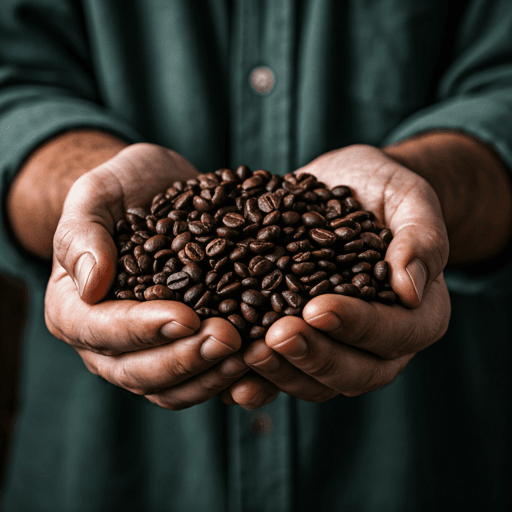
A coffee gene bank is a farm. Not a freezer, not a vault under a mountain — a block of living coffee trees, planted in rows, pruned and weeded and harvested by people on a payroll, year after year, indefinitely. Coffee gene banks take that form because coffee seed will not survive the treatment that makes ordinary seed banking cheap: it cannot be dried hard and frozen without dying. Almost everything strange, expensive and precarious about the way coffee's genetic heritage is conserved follows from that single botanical fact.
The comparison people reach for is the Svalbard Global Seed Vault, the Arctic backup facility that holds an enormous number of dried seed samples in permafrost. There is no Svalbard for coffee, and there cannot be one on the same terms. Wheat, rice, barley and beans can be dried to very low moisture, sealed in foil, held below freezing and left alone for decades. Coffee cannot. So coffee's insurance policy is not a box on a shelf. It is an orchard that has to be kept alive.
What coffee gene banks actually are
Two words do most of the work here, and both are simpler than they sound.
Germplasm is just the living material that carries a plant's genetics — seed, seedlings, cuttings, tissue in a jar. A coffee germplasm collection is a deliberate assembly of that material, gathered so that its diversity is not lost.
An accession is one distinct entry in that collection: a single sample with an identity and a record behind it, such as seed gathered from one wild population in one forest on one collecting trip, or one named cultivated variety received from another institution. An accession is not a tree; it is a line, usually represented in the field by a small block of trees so that losing one plant does not lose the entry. Collections are counted in accessions, and a large coffee collection is usually described in thousands rather than the tens or hundreds of thousands routine in a cereal bank.
Two other terms recur below. Ex situ conservation means holding material away from where it grew — a planted collection, a laboratory, a freezer. In situ conservation means protecting the place itself, so the population keeps growing, evolving and reproducing where it always has. Coffee needs both, for reasons that become obvious once the seed problem is clear.
At a glance: cereal seed bank vs coffee field collection
| Aspect | Conventional seed bank (wheat, rice, beans) | Coffee field gene bank |
|---|---|---|
| What is stored | Dried seed in sealed packets | Living trees planted in the ground |
| Conditions | Very low moisture, sub-zero temperature | Whatever the weather does that year |
| Time between interventions | Long — often decades before regeneration | Continuous; trees need care every season |
| Cost shape | Heavy at the start, light afterwards | Recurring forever, with no visible output |
| Land needed | A room | Cultivated land, held permanently |
| Main threats | Power failure, flooding of the facility | Storm, fire, drought, disease, land-use change, funding cuts |
| Backup copy | Ship a duplicate box to another vault | Plant a second orchard on another site |
| Identity risk | Low — the packet is labelled once | Higher — labels must survive decades of replanting |
| Who uses it | Breeders and researchers | Breeders and researchers |
The seed problem, in plain words
Seed storage behaviour is usually sorted into categories. Orthodox seed tolerates being dried very hard and then frozen; it survives, sometimes for a very long time, and this is what conventional seed banking is built on. Recalcitrant seed is the opposite: it will not tolerate serious drying at all, and dies quickly in storage.
Coffee is very often called recalcitrant in popular coverage, and for practical purposes the consequence is the same — you cannot bank it like wheat. But the botanical literature is more specific, and it is worth getting right: Coffea is generally treated as the textbook case of an intermediate seed, a middle category between the two. Intermediate seed tolerates partial drying but not the extreme dehydration orthodox banking requires, and it is separately sensitive to low temperature, which means the standard sub-zero step can kill it even at a moisture content it would otherwise survive. Published work also reports that this tolerance varies between Coffea species — some are dry enough tolerant to be cryopreserved, others are not — so there is no single threshold that applies to the genus as a whole.
The practical upshot is what matters to the collection manager. Coffee seed is short-lived relative to cereal seed. Reported viability windows are commonly described in months under ordinary conditions rather than in years or decades, and the figures quoted vary a good deal by species, ripeness, moisture content and handling, so treat any confident single number with suspicion. What is not in dispute is the direction: you cannot put coffee seed on a shelf and come back in thirty years.
Is there a laboratory route around this? Partly. Cryopreservation — storing tissue at the extremely low temperature of liquid nitrogen — has been researched for coffee for decades, and protocols have been published for material such as embryos and embryogenic tissue as well as, for some species, seed. It works in experimental settings. It is not, however, a drop-in replacement for a field collection: it demands specialised laboratory capacity, a reliable cryogen supply, trained staff and a protocol validated for the particular material, and it has not displaced living collections as the backbone of coffee conservation. In-vitro slow-growth culture is used similarly, as a medium-term holding measure rather than a substitute. Anyone who tells you coffee cryobanking is solved and routine is running ahead of the published record.
What a living collection actually takes
Picture the alternative honestly. To conserve a coffee accession, someone plants it. Then someone shades it, weeds around it, prunes it, watches it for leaf rust and berry disease, replaces the plants that die, keeps the labels legible, records what happened, and does all of that again next year, and the year after, for as long as the institution exists. When trees age out, the block has to be replanted — and replanting is the moment when an accession is most likely to be quietly lost or mixed up, because at that moment the entry depends entirely on records and labels rather than on the plant itself.
That workload has three properties that make it institutionally fragile. It is recurring: the bill arrives every single year, in land, labour and attention. It is unglamorous: nothing is published, nothing is launched, nothing photographs well, and a good year looks exactly like the last one. And it is easy to cut: a collection maintained for decades does not visibly fail the month its budget is trimmed. It fails three or four years later, when a block that was not replaced turns out to have been the only surviving copy of something.
The scale of that risk is not hypothetical. A published review of one major international coffee collection reported that dozens of accessions had been lost over a period of years, and classified the large majority of what remained as threatened and in need of intervention — in a collection that is professionally run and internationally known. A global conservation strategy prepared for coffee genetic resources by research and conservation organisations reached a blunter verdict still, describing the existing arrangement of collections as neither secure nor sustainable, with important collections in poor physical condition and short interruptions in funding producing losses that cannot be reversed.
Duplication, the standard answer everywhere else in crop conservation, is correspondingly demanding here. Backing up a cereal accession means posting a second packet to another vault. Backing up a coffee accession means finding land in a suitable climate, planting a second orchard, and funding its upkeep too — forever. Safety duplication for coffee is not a shipping arrangement. It is a second permanent institution.
One real example, and why it is only one
The best-known field collection in the coffee world is held at CATIE, an agricultural research centre in the Turrialba valley of Costa Rica, whose international coffee collection is reported to include wild material gathered on twentieth-century collecting missions in Ethiopia alongside a long list of cultivated types. It is the collection most often cited as the reference case for how ex situ coffee conservation is actually done, and it is also the collection whose documented losses illustrate the fragility described above. The valley itself, and the institution's place in it, are covered on our Turrialba coffee page.
Other significant collections exist in producing countries, several of them large, and the collections held in the arabica homeland are generally described as the most diverse of all. Naming and sizing those precisely is where popular coverage goes wrong most often, because figures are reported inconsistently and change as collections are rationalised, merged or re-audited; treat any specific count you see as approximate unless it is sourced to the institution itself. The honest summary is that coffee's ex situ safety net is a handful of orchards in a handful of countries, and that no two published accounts of its size quite agree.
Ex situ and in situ: why coffee needs both
A planted collection can only hold what someone went out and collected. Everything not collected — and, crucially, everything still evolving in response to pests, drought and heat in the forests where wild Coffea species grow — exists only in place. That is the case for in situ conservation: protecting habitat so populations continue to adapt, rather than sitting frozen at the moment they were sampled.
The gap between the two is large. The most widely cited assessment of the genus applied extinction-risk criteria to the wild coffee species then recognised and concluded that a majority of them qualify as threatened. The same body of work reported that a large share of wild coffee species are held in no living collection or seed bank at all, and that a further group are not known from any protected area. Those proportions are the honest headline: neither approach on its own is close to complete coverage, and the species most likely to matter for future breeding — the drought-tolerant, heat-tolerant, disease-resistant outliers — are often the ones least represented in either.
There is also a diversity that lives mostly in place rather than in an orchard: the forest and garden landraces of Ethiopia, whose story is told on our guide to heirloom coffee.
Who the material is for
Gene banks are not seed catalogues. You cannot order an accession as a consumer, and the collections are not trying to sell you anything. Their users are plant breeders and researchers, who request specific accessions under a formal material transfer agreement — a document setting out what the recipient may do with the material and what happens if something derived from it is later released.
Coffee's legal position here is unusual and worth knowing. Many staple crops are covered by the multilateral access system of the international plant treaty, which gives breeders relatively standardised access to a listed set of crops. Coffee is not on that list. Access to coffee germplasm is therefore negotiated bilaterally, country by country, under the access-and-benefit-sharing framework that grew out of the Convention on Biological Diversity. In practice that means slower, more individual arrangements, and it is one reason material moves between coffee collections less freely than a newcomer might expect — and one reason the global strategy documents keep returning to workable access rules as a conservation issue, not merely a legal one.
A gene bank also sits upstream of the whole seed chain that eventually reaches a farm. What a breeder receives from a collection is a starting point; the separate machinery of mother trees, controlled nurseries, chain-of-custody records and verified planting material is a different job entirely, and one we cover in coffee seed certification.
The quiet infrastructure behind named varieties
Here is why any of this reaches a cup. Almost every improved coffee variety with a name on it is the product of crossing something with something else, and at least one side of that cross usually came out of a collection rather than off a farm. Disease resistance in particular tends to be found in wild or unimproved material that nobody was drinking — collected, planted, maintained for years by people whose names never appear on the variety, and then requested by a breeder who needed exactly that trait and nothing else about the plant.
The clearest single case is the Timor Hybrid, the naturally occurring arabica-robusta cross whose rust resistance became the backbone of a whole generation of released varieties; its own story is on our Timor Hybrid page. The general pattern holds well beyond it. When a block of trees shrugs off an outbreak that flattens the farm next door, the reason is usually a trait that was sitting in a field collection a decade or two earlier, being weeded by somebody who had no idea which accession would matter.
That is also why mislabelling matters so much. A collection whose records have drifted does not fail loudly; it quietly hands a breeder the wrong thing, and the error surfaces years later as a variety that does not behave as advertised, or a bag whose stated variety name means nothing verifiable. In a freezer, identity is fixed the day the packet is sealed. In an orchard, identity has to be re-established every time a tree is replaced.
The honest problem
The structural difficulty is that the beneficiaries of coffee gene banks are diffuse and in the future, while the costs are specific and in the present. A collection protects growers who do not know they will need it, against diseases and climate stresses that have not arrived yet, using material whose value will not be apparent for a decade or more. Nobody at the till is paying for it. The organisations that maintain the collections are typically national research institutes and international centres operating on grant cycles far shorter than the working life of a coffee tree, let alone the life of a collection.
None of this is unsolvable, and there has been real movement — coordinated strategy work across institutions, prioritisation exercises that rank accessions by uniqueness and threat so that scarce effort goes to the irreplaceable entries first, safety-duplication planning, and continued laboratory research into cryopreservation as a genuine long-term backup rather than an experiment. But the fundamental asymmetry stands. A cereal crop's insurance policy can largely be paid once. Coffee's has to be paid every year, in fieldwork, by institutions that must justify the expense to somebody every budget cycle.
The bottom line
Coffee gene banks are orchards because coffee seed cannot be banked like grain — it will not tolerate the drying and freezing that makes conventional seed storage cheap and near-permanent. That single constraint converts conservation from a storage problem into a farming problem, with land, labour, weather, disease and record-keeping all in the way, and it removes the option that every cereal crop has: a cheap, duplicated, walk-away backup. It is the least visible infrastructure in coffee and arguably the most consequential, because it is where the traits that will keep coffee growing under a changing climate are currently sitting, in rows, being weeded by somebody.