
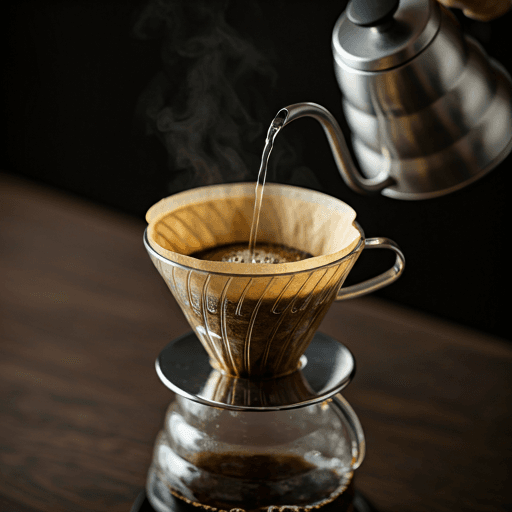
Coffee art means two related things, and this guide covers both. The first is latte art: the hearts, leaves, and tulips a barista pours into the steamed-milk foam on top of a latte, flat white, or cappuccino. The second is coffee used as an actual art medium, where brewed coffee becomes a sepia paint for illustrations and portraits. Both turn an ordinary cup into something worth photographing, and both are simpler to understand than they look.
What coffee art means
People use the phrase "coffee art" loosely, so it helps to split it in two. In a cafe, coffee art almost always means latte art: the white-on-brown design floating on a milk drink. In a gallery or at a craft fair, the same words describe coffee artwork in the literal sense, art made out of coffee, where someone has used a brewed cup the way a painter uses watercolor. There is even a third, smaller sense, art about coffee, meaning the paintings, prints, and photographs that take cafes, cups, and beans as their subject. This guide is the hub for all of it and links out to the drink-and-tools pages where each belongs.
What ties these together is that coffee is unusually photogenic and unusually willing to become a material. The same crema and microfoam that make a good espresso drink taste right also give a barista a canvas. The same tannins that stain your favorite mug let an illustrator wash sepia tones onto paper. Artistic coffee, in other words, is partly an accident of chemistry and partly a culture that grew up around sharing it.
Latte art: designs poured in milk foam
Latte art is the most familiar kind of coffee art. A barista pulls a shot of espresso, steams milk into a smooth, paint-like foam, and pours that foam through the dark crema so the white milk draws a pattern on the surface. It works because two textures meet: the deep brown crema underneath and the bright white microfoam on top give the contrast that makes a design readable. For the underlying drink itself, see our guide to what a latte is.
Crucially, latte art is not just decoration. A clean, symmetrical pour signals that the milk was steamed correctly, into glossy microfoam rather than stiff, bubbly froth, and that the espresso had a thick, fresh crema to pour into. That is why baristas treat it as a skill worth competing over, and why a sloppy heart often hints at a flat, over-aerated drink underneath. Good-looking foam and good-tasting foam usually come from the same technique.
Free pour versus etching
There are two ways to make a latte-art design. Free pouring is the true barista method: the design is created entirely by how the milk is poured, with no tools touching the surface. The barista controls the height, speed, and wiggle of the pour to lay the pattern down in one continuous motion. Etching is the beginner-friendly route: you pour a plain layer of foam, then drag a thin tool, a pick, skewer, or the tip of a spoon, through it to draw shapes, sometimes adding dots of chocolate sauce or matcha for contrast. Free pouring rewards better milk and more practice; etching gives you more control while your foam is still a work in progress.
The three classic patterns
Almost every poured design grows out of three shapes:
- The heart. The simplest and most forgiving. You pour into the center, let a white circle bloom, then cut straight through it to draw the point. Most baristas learn this first.
- The rosetta (or leaf). A fern-like pattern made by rocking the pitcher side to side as you pour to lay down ripples, then pulling the stream straight through the middle to finish the stem.
- The tulip. Two or more stacked hearts, built by pausing and pushing fresh bursts of foam into the cup so they layer up like petals.
From these three, skilled baristas build swans, phoenixes, and intricate multi-layer scenes, but the heart, rosetta, and tulip remain the foundation. If you want to try at home, the make-or-break factor is your milk texture, so start with our milk frother guide rather than chasing the pour first; warm, silky microfoam is what makes any of these patterns possible.
Coffee as an art medium
The second meaning of coffee art steps out of the cup entirely. Here, brewed coffee is the paint. Because coffee is rich in tannins, the same compounds that stain mugs and teeth, it adheres to paper and dries into warm browns, sepias, and siennas. Artists work much like watercolorists, building a piece from light washes to dark, since coffee, once it stains, is hard to lift back out.
Coffee painting and coffee-wash illustration
To make coffee paint, you simply brew it strong or dissolve instant coffee in a little water; more water gives a pale wash for backgrounds, less water gives a rich mid-tone for shadows. A roughly 1:15 dilution lays down delicate highlights, while something closer to 1:8 paints deeper tones. The appeal is obvious: it is inexpensive, non-toxic, biodegradable, and it smells wonderful while you work. The trade-off is that it is monochrome and fades more than dedicated pigments, so finished coffee artwork is usually sealed and kept out of direct sun.
Foam portraits, bean mosaics, and art about coffee
Coffee shows up as a medium in other ways, too. Some baristas create detailed foam portraits, using etching and sometimes stencils and powders to render faces, animals, or logos on the surface of a drink, closer to drawing than to free-pour latte art. Crafters build coffee-bean mosaics, gluing whole roasted beans into images and lettering. And plenty of conventional artists simply make art about coffee: the cafe scenes, still lifes, and prints that hang in coffee shops everywhere. All of it counts as coffee art in the broad sense.
Where you see each kind of coffee art
| Style | How it is made | Where you see it |
|---|---|---|
| Free-pour latte art | Steamed microfoam poured through crema in one motion | Specialty cafes; the heart, rosetta, and tulip on your latte or flat white |
| Etched latte art | Plain foam drawn into with a pick or spoon, plus sauce dots | Home drinks and seasonal cafe specials; detailed foam portraits |
| Coffee painting / wash | Brewed or instant coffee used as sepia watercolor, light to dark | Sketchbooks, craft fairs, and illustration prints |
| Coffee-bean mosaic | Whole roasted beans glued into images or lettering | Cafe wall decor, signage, and craft displays |
| Art about coffee | Conventional painting, print, or photography of cafe life | Coffee-shop walls and the broader art-cafe scene |
Coffee art culture: competitions and social media
Latte art turned into a sport. The World Latte Art Championship, held annually since the mid-2000s, sends national champions head to head to pour set designs that judges score on symmetry, contrast, definition, and how well the pattern is centered in the cup. The format even splits the precise poured rounds from a freer "art bar," where competitors perform showpiece designs for a crowd. You do not have to compete to take part in the culture, though; social media did most of the work, turning a fleeting design that lasts a few sips into a global, shareable craft. A clean rosetta is one of the most photographed things in any cafe.
That visibility is part of why latte art became a near-universal marker of specialty coffee, and why so many baristas treat the pour as a point of pride. If the craft side appeals to you, our guide on how to become a barista covers the skills, latte art included, that the job is built on.
How to tell good latte art from a pretty accident
You do not need to pour to appreciate coffee art. A few things separate a skilled cup from a lucky one:
- Contrast. Crisp white-on-brown edges mean fresh crema and well-textured milk; a gray, blurry design usually means flat espresso or bubbly foam.
- Symmetry and centering. The pattern should sit balanced in the middle of the cup, not slide off to one side.
- Definition. Clean lines in a rosetta's ripples or a tulip's layers show real pour control.
- It tastes right, too. The best sign of all is that the silky foam that drew the picture also makes the drink smooth to sip.
Where coffee art fits in cafe culture
Coffee art lives at the meeting point of a craft drink and a creative scene, which is exactly why it travels so well from the espresso bar to the gallery wall. Some venues lean all the way into it: an art cafe pairs the cup with paintings, workshops, and exhibitions, making the link between coffee and creativity literal. Whether you are admiring a rosetta, washing sepia onto paper, or just enjoying the prints on a cafe wall, it is all the same impulse, taking something you drink every day and making it worth a second look. Pour your own, photograph someone else's, or simply notice the next heart that lands on your cup.