
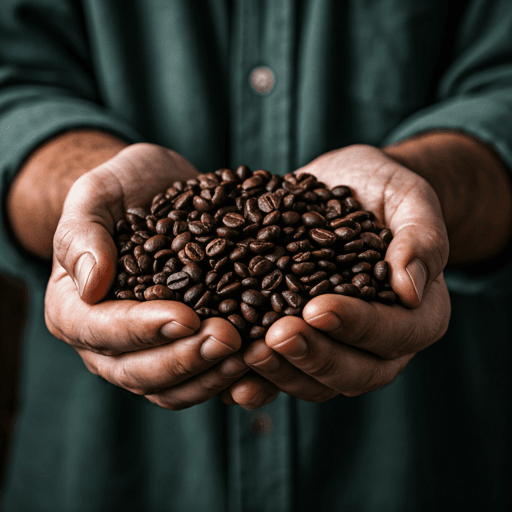
The tupi coffee variety is a compact Brazilian arabica cultivar bred for resistance to coffee leaf rust, developed by the Instituto Agronomico de Campinas (IAC) in Sao Paulo state and released at the very end of the 1990s. It belongs to the Sarchimor family, the lineage that descends from crossing the dwarf Costa Rican Villa Sarchi with the rust-resistant Timor Hybrid, and it was selected to give growers rust protection without asking them to give up the short, dense plant Brazilian farms are built around.
That last clause is the entire point of Tupi. Rust-resistant material was not scarce by the 1990s. What was scarce was rust-resistant material that behaved like the cultivars Brazilian farms had already standardised on: low-growing, tight-framed, plantable at high density, and reachable by a harvester. Tupi is the Brazilian answer to that specific problem, and almost every trait described below follows from it.
Where the tupi coffee variety came from
The pedigree behind Tupi starts outside Brazil. At the Centro de Investigacao das Ferrugens do Cafeeiro (CIFC) in Oeiras, Portugal, researchers crossed a rust-resistant Timor Hybrid plant catalogued as CIFC 832/2 with the compact Costa Rican dwarf Villa Sarchi. The resulting hybrid, recorded as H 361/4, is the ancestor of the entire Sarchimor group; the wider family tree is covered in the Sarchimor variety guide. The resistance itself came from the Timor side of that cross, a natural arabica-robusta hybrid found on Timor and used as the resistance donor in most modern rust-resistant cultivars, explained in the Timor Hybrid guide.
Brazilian sources are consistent on what happened next. IAC received seed of H 361/4 in the F2 generation in 1971, and the population raised from that seed was catalogued under the number 1669. Individual plants within it were then advanced by genealogical, or pedigree, selection over successive generations, with selection carried out at more than one location while the material was still segregating. Two of those individual plants became the best-known named outcomes: plant 33 became Tupi IAC 1669-33, and plant 20 became Obata IAC 1669-20. Tupi and Obata are therefore siblings out of the same population, not a parent and a child.
Release dates are where accounts diverge, and it is worth being explicit about that. Brazilian institutional descriptions report that Tupi IAC 1669-33 was entered in the national cultivar register in 1999 and officially launched by IAC in 2000. Shorter English-language summaries often compress that into a single late-1990s date, which is why you will see the year quoted inconsistently. The difference is almost certainly registration versus launch, and "released at the end of the 1990s" is the safe statement.
One further caution on pedigree. Popular write-ups sometimes describe Brazilian Sarchimor selections as having been crossed back toward local commercial cultivars such as Catuai or Mundo Novo. The IAC record for Tupi itself describes pedigree selection within the descendants of H 361/4, not a documented backcross. Sources differ, so this page states only what is well attested: Sarchimor lineage, Timor Hybrid as the resistance donor, Villa Sarchi as the compact parent, and IAC as the selecting institute.
The one thing it was bred for: rust resistance on a mechanisable plant
Coffee leaf rust, caused by the fungus Hemileia vastatrix, strips leaves, starves the plant of the photosynthesis it needs to fill cherry, and forces repeated fungicide rounds; the disease itself is covered in the coffee leaf rust guide. In Brazil it has been present since the early 1970s and is managed as a permanent cost of production rather than an occasional emergency.
What makes Tupi distinctive within that picture is not that it resists rust, but the frame the resistance arrived in. Brazilian arabica farming, particularly across the plateaus of Sao Paulo and Minas Gerais, runs on dwarf plants set close together in rows, often with mechanical or semi-mechanical harvesting. A rust-resistant cultivar that grew tall, spread wide, or ripened out of step with the rest of the block would be an agronomic problem dressed as a solution. Tupi was selected to fit the existing system: short stature, a narrow canopy, and a maturation window that opens early rather than late.
Brazilian recommendations place it preferentially in dense, super-dense or row-style plantings, with the spacings quoted for it sitting in the narrow-row range rather than the traditional wide-square one. That is a direct statement about architecture. Nobody recommends a cultivar for high-density blocks unless its canopy stays small enough to keep those blocks workable at maturity.
What the plant actually looks like
Tupi IAC 1669-33 is a dwarf, or porte baixo, cultivar. Brazilian institutional descriptions note that both plant height and canopy diameter at around six years of age are smaller than in Obata IAC 1669-20 and in Catuai Vermelho, the reference dwarf of Brazilian planting. New leaf flush is bronze rather than green, which is a genuinely useful field marker in a young block where several dwarf cultivars sit side by side.
The fruit is red, large and rounded, and it ripens early, ahead of both Catuai Vermelho and its sibling Obata. Bean size is described as larger than Catuai Vermelho, with average screen size commonly reported at around 17. Screen figures move with year, nutrition and crop load, so treat that as a typical value rather than a specification.
On yield, Brazilian descriptions call production good and broadly comparable to Catuai Vermelho. Published productivity numbers are deliberately kept out of the summary here, because they come from specific trials under specific spacing, pruning and irrigation regimes and do not transfer to another farm.
How Tupi behaves for a grower
Three practical traits come up repeatedly in Brazilian descriptions, and together they define who should and should not plant it.
First, it is nutritionally demanding. Tupi is recommended for fertile soils and growers are advised to keep fertility high; a high-density block of a hungry cultivar concentrates that demand further. It is also frequently described as a good fit for irrigated or fertigated systems, which is the same trait seen from the other direction.
Second, it is more sensitive to drought than Catuai Vermelho IAC 99. That is a meaningful limitation in a country where much of the arabica belt is rainfed and dry spells during cherry filling are a recurring risk. Early maturation partly offsets this by pulling the fruit-filling period forward, but a drought-sensitive plant in a drought-prone block is still a risk decision.
Third, it responds well to mild climates and fertile ground, yet it has also performed in warmer, lower country. A long-running trial at Jaboticabal in Sao Paulo state, at roughly 565 metres above sea level, compared seventeen dwarf arabica cultivars across six consecutive harvests and placed Tupi IAC 1669-33 among the highest-yielding of them, with good adaptation to that low-altitude, higher-temperature setting. Related work at the same site also found Tupi responsive to skeleton pruning, recovering productively after the cut. That is one location and one research programme rather than a general altitude recommendation, but it does indicate the cultivar is not restricted to cool highland blocks.
Early ripening has a scheduling consequence worth naming. A cultivar that matures ahead of Catuai spreads the harvest calendar, letting a farm open picking or mechanical harvesting on one block before the main body of the crop is ready. On a large property that staggering is genuinely valuable, and it is one of the quieter reasons Brazilian farms keep an early cultivar in the mix.
What it tastes like, and what nobody claims for it
Cup quality for Tupi was assessed in Brazil at the Institute of Food Technology and classified as normal, comparable to Catuai Vermelho. That is a deliberately unglamorous verdict and it is the honest one: Tupi was not selected as a flavour cultivar, and no serious Brazilian source presents it as one. It is a sound commercial arabica whose selling argument is field behaviour, not the cup.
This matters when reading marketing copy that treats any rust-resistant Sarchimor selection as either automatically inferior or secretly exceptional in the cup. Neither is supported for Tupi. Processing, altitude, ripeness at picking and drying discipline will move a Tupi lot far further than the cultivar name does, which is true of most commercial arabicas and especially true of one benchmarked as normal against the national standard.
The honest limits of its rust resistance
Resistance inherited from the Timor Hybrid is not permanent anywhere, and Tupi is one of the clearer illustrations of why. Rust exists as many physiological races, populations shift, and a resistance gene that stops today's races may not stop tomorrow's.
Brazilian research has documented this for Tupi specifically. Reviews of leaf rust in Brazil describe Tupi IAC 1669-33 as highly resistant across several regions of the country but rated moderately resistant to susceptible at some locations where more virulent races of H. vastatrix are present, and note that it is among the Sarchimor-derived cultivars beginning to lose their high resistance in places. Separately, test-cross work at the Parana agronomic institute, published in 2007 and covering both Tupi IAC 1669-33 and IAPAR-59, reported that many individual parent plants of these cultivars carried resistance genes already defeated by the rust races present at that site, or carried them in heterozygous form, since susceptible plants segregated out of some of the test crosses.
The fair summary is this: Tupi has held up better under rust pressure than susceptible types such as the traditional Bourbon and Typica descendants, and better than Catuai, but its resistance is neither complete nor permanent and it varies by location. Anyone planting it should still plan a monitoring and management programme rather than treating the cultivar as a solved problem.
Nematodes: what belongs to Tupi and what does not
Root-knot nematodes are a separate problem from rust, and this is where Tupi is most often misdescribed. Tupi IAC 1669-33 is not a nematode-resistant cultivar. A study presented in Brazil tested it against Meloidogyne paranaensis at rising inoculum levels and found moderate resistance at the two lower levels but susceptible reactions at the two higher ones, which is a warning against treating any partial reading as field protection.
The nematode credential belongs to a different selection from the same population. Plant 13 of the 1669 family stood out in Campinas for production, seed size, rust resistance and resistance to the root-knot nematode Meloidogyne exigua, and its later generations were developed into a registered cultivar. In the literature that line appears under several working names, including IAC 1669-13, IBC 12 and Tupi RN IAC 1669-13, before being registered by IAC in 2012 as IAC 125 RN, with reported resistance to two races of M. exigua and to one race of M. incognita. If a seller or a spec sheet attaches nematode resistance to plain Tupi, the claim has been transferred from the wrong sibling.
Two practical points follow. Nematode resistance is species-specific and often race-specific, so a claim about one species says nothing about another. And blocks with a known nematode history need a soil diagnosis identifying which species is present before a cultivar name is chosen at all.
Tupi coffee variety at a glance
| Attribute | Tupi IAC 1669-33 |
|---|---|
| Species and group | Coffea arabica; Sarchimor lineage |
| Breeding institute | Instituto Agronomico de Campinas (IAC), Sao Paulo, Brazil |
| Parentage | Pedigree selection from hybrid H 361/4 (Villa Sarchi x Timor Hybrid CIFC 832/2); F2 seed received by IAC in 1971, catalogued as population 1669 |
| Release | Registered in the national cultivar register in 1999, launched by IAC in 2000; some summaries quote a single late-1990s date |
| Plant stature | Dwarf; height and canopy at about six years smaller than Obata and Catuai Vermelho |
| New leaf colour | Bronze |
| Cherry | Red, large, rounded |
| Maturation | Early; ahead of Catuai Vermelho and Obata |
| Bean size | Larger than Catuai Vermelho; average screen commonly reported around 17 |
| Cup | Assessed in Brazil as normal, comparable to Catuai Vermelho; not selected as a flavour cultivar |
| Leaf rust | Highly resistant in several Brazilian regions, but moderately resistant to susceptible at some locations; never permanent |
| Nematodes | Not a nematode-resistant cultivar; the M. exigua credential belongs to the sibling plant-13 line registered as IAC 125 RN |
| Best suited to | Fertile soils, mild climate, dense or row plantings, irrigated or fertigated systems; also productive in low-altitude trials |
| Known weaknesses | Nutritionally demanding; more drought-sensitive than Catuai Vermelho IAC 99 |
How Tupi compares with its nearest relatives
Its closest relative is Obata IAC 1669-20, selected from the same F2 population. In practice the two split on size and timing: Tupi is the smaller, earlier plant, Obata the larger-framed and later one. A farm choosing between them is usually choosing between a tighter, earlier block and a more vigorous, later one, and plenty of Brazilian properties plant both precisely to widen the harvest window.
IAPAR-59 comes from the same Villa Sarchi by CIFC 832/2 cross but was selected by the Parana institute rather than IAC, so it is a separate pedigree line with its own field record. The 2007 test-cross study examined both cultivars together and found defeated or heterozygous resistance genes segregating in parent plants of each, which is a useful corrective to any assumption that one Sarchimor selection is permanently safer than another.
Catuai is the benchmark rather than a relative. It is the compact Brazilian workhorse Tupi was measured against on almost every trait: stature, canopy, yield, bean size, ripening date, drought tolerance and cup. Catuai is not rust resistant, which is the trade Tupi exists to offer.
Behind Catuai stands Mundo Novo, the tall, high-yielding Bourbon-by-Typica selection that made Brazilian arabica productive in the first place and that was crossed with Caturra to create Catuai; the Mundo Novo guide covers that story. Reading the sequence in order, Mundo Novo for productivity, Catuai for compactness, Tupi for compactness plus rust resistance, is the clearest way to see what each generation of Brazilian breeding was actually solving.
The bottom line
Tupi is a working cultivar rather than a famous one. It exists because a large, mechanised, rust-exposed coffee sector needed resistance delivered inside a plant it already knew how to grow, and it delivers precisely that: a dwarf, early-ripening, large-beaned arabica with a Sarchimor pedigree and a yield record comparable to the compact cultivars it sits beside. Its limits are equally clear. It wants fertility, it dislikes drought more than Catuai does, its cup was never the argument, and its rust resistance has proved partial in places. Judged against what it was bred to do, it holds up well; judged as a permanent answer to rust, nothing in this lineage ever will be.
Frequently asked questions
What is the tupi coffee variety? Tupi is a dwarf arabica cultivar developed in Brazil by the Instituto Agronomico de Campinas and selected for resistance to coffee leaf rust. It belongs to the Sarchimor lineage, descending from a Villa Sarchi crossed with the Timor Hybrid, and was released at the end of the 1990s.
What are Tupi's parents? It was selected from the descendants of hybrid H 361/4, a cross of the Costa Rican dwarf Villa Sarchi with Timor Hybrid CIFC 832/2. IAC received that material as F2 seed in 1971 and advanced it by pedigree selection. Accounts that add a backcross to Brazilian commercial cultivars are not supported by the IAC record, so treat that detail as unverified.
Is Tupi still resistant to leaf rust? Largely, but not completely and not everywhere. Brazilian reviews describe it as highly resistant in several regions yet moderately resistant to susceptible at some locations carrying more virulent rust races, and a 2007 test-cross study found resistance genes already defeated locally or present in heterozygous form. Resistance derived from Timor Hybrid ancestry has broken down against newer rust races in several countries and should never be assumed permanent.
How is Tupi different from Obata? They are siblings from the same 1669 population. Tupi is the smaller plant with the earlier harvest; Obata is larger-framed and later ripening. Both carry the same Sarchimor ancestry and the same caveats about resistance durability.
Does Tupi resist nematodes? No. Testing against Meloidogyne paranaensis showed moderate resistance only at low inoculum levels and susceptibility at higher ones. The nematode credential in this family belongs to the separate plant-13 selection, known during development as Tupi RN IAC 1669-13 and registered by IAC in 2012 as IAC 125 RN.