
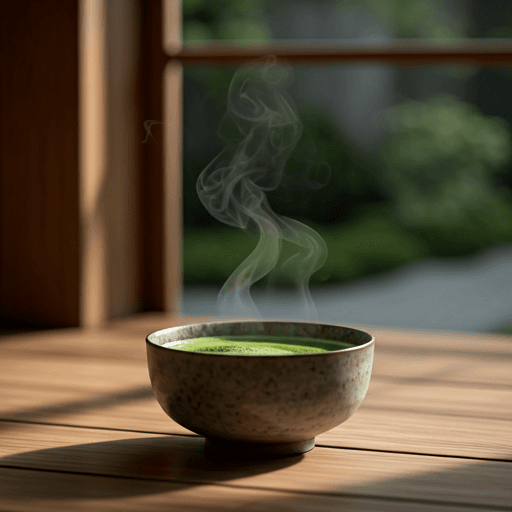
Ireland grows no tea in any commercial sense, so Irish tea is not an origin at all — it is a blending specification. The words describe a style of black tea rather than a place that produced it: strong, brisk, heavy in the cup and built to be drunk with milk. Every leaf in it is grown somewhere else and arrives finished.
That is an unusual situation and worth taking seriously. Almost everywhere else, a country's tea character is explained by ground — altitude, soil, cultivar, the shape of the growing season. Strip all of that away and you would expect nothing to be left. In Ireland's case something substantial is left, and it is recognisable to anyone who has drunk it. What that something is made of is the real question.
Does Ireland grow tea? The short answer, and the honest one
No. There is no commercial tea cultivation in the country: no planted estates, no processing factory, no grade sheet, no auction, no export line. Tea does not appear in Irish agricultural output for roughly the same reason bananas do not.
What confuses people is that the plant will live in Ireland. Ornamental camellias flower in sheltered gardens across the milder parts of the island, and Camellia sinensis itself can be kept as a garden shrub in a favourable spot. It is reasonable to look at that and ask why nobody has scaled it up. The answer is that surviving and yielding are two different tests, and the tea bush only passes the first.
Why the tea bush will not flush in Ireland
The intuitive explanations are the wrong ones. Ireland is not too cold for tea: winters are mild by the standards of anywhere at the same latitude, hard frost is uncommon near the coast, and a mature tea bush is a good deal hardier than its tropical reputation suggests. Nor is it too wet. Tea is a rain-loving crop, and a damp maritime climate is closer to what the plant likes than most people assume.
The constraint is summer warmth, and it is worth being precise about it. What a tea garden harvests is not the plant but its repeated regrowth: the bud and the young leaves that push out after each plucking round. That flushing behaviour is driven by accumulated heat. Growing guidance for the plant generally places productive shoot growth in a band running from roughly the high teens Celsius into the mid-twenties, sustained across a long season — sources differ on the exact edges of that band, but not on its shape. Ireland's national meteorological service describes inland air temperatures as normally reaching 18 to 20 °C on summer days, and describes cloud cover, humidity and rainfall increasing from late June into July as the airflow turns westerly off the ocean.
Put those two descriptions against each other and the outcome follows. A tea bush in Ireland spends a brief part of the year at the very bottom of its working range and the rest of it barely ticking over. Shoots extend slowly. Flushes are few, and thin when they come. The plucking round — the interval between passes over the same bush — stretches out until the arithmetic of a working garden collapses. It is not that nothing grows; it is that not enough grows, often enough, to fill a factory.
Two further constraints finish the argument. Tea is picked by hand, repeatedly, over many months, and a short season with small flushes drives the hand labour needed per finished kilogram to a level no commercial planting in a high-cost economy could carry. And withering troughs, rollers, oxidation beds, driers and sorters only earn their keep when a steady volume of green leaf arrives every day through the season. A few sheltered rows cannot feed a line like that, and nothing at the scale that could has ever been planted, because there has never been a reason to plant it.
At a glance: what tea needs, what Ireland has
| What a productive tea garden needs | What Ireland offers | Consequence |
|---|---|---|
| Sustained summer warmth to drive repeated flushing | Mild, cloudy summers; inland air temperatures described by the national meteorological service as normally reaching 18 to 20 °C on summer days | The decisive constraint — slow shoot extension, few usable flushes |
| A long growing season with short intervals between plucking rounds | A brief warm window between long cool shoulders | Plucking rounds stretch out; yield per bush collapses |
| Strong light through the growing months | Increasing cloud and humidity through midsummer, with frequent Atlantic frontal weather | Less energy available for the regrowth that harvesting depends on |
| Freedom from severe winter cold | Genuinely mild winters, frost-scarce near the coast | The one requirement Ireland comfortably meets |
| Acid, free-draining soil | Widely available, including acid peaty and granite-derived ground | Not the limiting factor either |
| Enough daily green leaf to justify a processing line | Nothing at that scale exists | Even a successful planting would have nowhere to send its leaf |
Irish tea is a specification, not a place
So the crop is absent. The identity is not. Three things carry it, and none of them happens on a farm.
1. Blending, treated as a written standard
The national style is a house specification rather than a harvest. Blenders buy against a target — a defined strength, colour, briskness and body — and adjust the buying list season by season so the cup stays the same while the crops behind it change. That is the opposite of single-origin thinking, where the whole point is that this year differs from last year. In a blending culture, consistency is the product, and the skill sits in the tasting room rather than in the field.
The specification leans hard on strong, malty, deeply coloured leaf, which is why East African and Assam teas sit at the centre of the buying lists; the leaf type itself is explained in our guide to Assam and black tea. The composition, flavour and brewing of the resulting blend are a subject of their own, covered in our guide to Irish breakfast tea; this page does not re-teach the cup, because the point here is the country behind the name, which grows none of it.
The one thing worth adding is that the specification is written for milk. A blend built to be admired without it would be a different product entirely. Strength, briskness and colour are chosen so that plenty survives the dilution, and that single constraint shapes every buying decision upstream of it — which leaf types are considered, which grades, which origins, and what a taster is listening for when a sample comes across the bench.
2. Water, described accurately
Water chemistry genuinely changes a strong black tea. Calcium and magnesium interact with the compounds that give a black infusion its colour and its edge, and the same leaf brewed in mineral-rich water tends to look darker and taste flatter than it does in soft water, where brightness and astringency come through more clearly. That much is well established, and it is a real reason a familiar blend can taste wrong when the same packet is opened somewhere else.
The folk claim that Ireland is uniformly soft-water country, though, does not survive contact with the geology, and it is better to say so than to repeat it. Much of the island is underlain by Carboniferous limestone, and rainwater percolating through limestone picks up hardness — which is why supplies drawn from the limestone midlands are among the harder ones in the country, and why several larger urban supplies are described as moderately hard. The soft water is real but regional: the granite and quartzite ground of the western seaboard and the granite uplands feed genuinely soft supplies.
The defensible version, then, is not that Irish water makes the tea. It is that a blend specified against one water behaves differently in another, and that a country whose water varies this sharply from one county to the next is drinking a more variable cup than the national image admits. That is a smaller claim than the folklore, and it has the advantage of being true.
3. Custom, which does most of the work
The third carrier is habit, and it is the strongest of the three. Tea arrived as an expensive import — accounts differ on exactly when it took hold — and stayed a luxury of the wealthy for a long time before spreading across households of every kind during the nineteenth century. By the twentieth it was not a drink so much as a default.
What that produced is a set of conventions as specific as any tasting protocol. Tea is brewed strong, and brewed long enough that the pot is doing real work. Milk is not optional. The number of cups in a day is high enough that the drink functions as punctuation rather than as an event, and the mid-morning tea break is an institution in its own right. Offering tea is the standard opening gesture of hospitality, and accepting is close to automatic; refusing tends to require a reason. Ireland is routinely placed at or very near the top of international comparisons of tea drinking per person, and while the underlying figures move around between sources and are worth treating with some caution, the ranking itself is consistently reported.
Strength, milk, frequency and social obligation: together those four things do the job that soil and altitude do elsewhere. They set expectations before the leaf is even bought, and a blender who ignored them would be selling something the country would not recognise. That is why the same specification reads as a national style rather than as a supermarket product.
How the leaf actually arrives
The supply chain behind all this has a specific history, and it explains the character of the leaf better than any climatic argument could.
For a long time, tea reached Ireland the way it reached most of Europe: through the London market, bought by blenders and wholesalers and sold on largely loose from chests. In the early 1940s that route was disrupted, supply tightened, and a state-backed importing company was set up in 1941 to buy directly from producing countries instead. Shipping capacity was the binding constraint on what it could achieve at first, but the structural decision outlasted the circumstances that prompted it: a successor body carried the same remit, and Irish importers were obliged to source directly from countries of origin until Ireland joined the Common Market in 1973.
Three decades of buying at origin, rather than picking through a distant market, built long-standing relationships with East African producers in particular. Those relationships, rather than any sudden change in taste, are the practical reason Irish buying lists tilted toward brisk African leaf with an Assam backbone. Preference and sourcing structure reinforced each other until they were hard to tell apart.
The form the leaf takes matters just as much. Most of it is CTC — cut, tear, curl — the processing method that reduces leaf to small uniform particles rather than twisted whole leaf. CTC extracts fast, brews dark and strong, and behaves predictably in a bag, which is exactly what a milk-forward specification and a nation of quick cups require. It is also the dominant form traded through the East African auction at Mombasa, described by its own trade association as the world's largest black CTC auction and a principal source for the European teabag market. Orthodox whole-leaf tea, prized elsewhere for the very qualities milk would erase, would be the wrong tool for this job.
What happens in Ireland, then, is tasting, blending, packing and distribution — real industry and real expertise, and no agriculture at all. Everything upstream of the warehouse door is someone else's crop.
Irish tea vs English tea
The two are neighbours in style and are constantly compared: the short version is that the Irish specification generally sits stronger, darker and more African-weighted than its counterpart, which is treated properly in our guide to English breakfast tea. Both are blends rather than origins, and neither country's identity depends on growing anything.
Could Ireland ever grow its own tea?
It can be done in the same climatic neighbourhood, which is the honest starting point. The best-known attempt is the Cornish estate covered in our guide to Tregothnan — a working planting in a mild, sheltered, Atlantic-facing setting not unlike parts of the Irish south and west. Smaller experimental plantings exist elsewhere in the wider region, including in Scotland and Wales, and none of them changes the overall picture.
There has been at least one serious attempt on the island itself. A tea business established a small garden at Portaferry, in County Down on the shore of Strangford Lough, choosing the site for its sheltered, near-frost-free conditions and checking it for soil, drainage, rainfall and sunshine before planting. Seed was sourced from several tea-growing countries, germinated and brought on under cover before the young plants were set out, and the growers have reported the bushes establishing, being pruned toward the flat plucking table of a mature garden, and eventually flowering. Beyond the growers' own updates the public record is thin, so the fair statement is that the plants took and that a sustained, documented harvest is not something the available reporting establishes.
That is the shape of the realistic ceiling. A sheltered micro-climate, a small planting, careful hand attention and a novelty output is achievable, and genuinely interesting. A crop that could supply even a fraction of national demand is not, and the reasons are the ones already given: too little summer heat to flush, too short a season, too much hand labour per finished kilogram, and no processing capacity to send green leaf to. A demonstration garden proves the plant will live. It does not prove an industry could, and the two should not be confused.
The bottom line
Irish tea is the clearest case anywhere of a national tea identity assembled entirely downstream of the farm. The country cannot grow the crop, chiefly because its mild, cloudy summers never accumulate the heat a tea bush needs to flush productively, and the labour and processing arithmetic closes the door behind that. What it has instead is a written blending standard, a supply chain shaped by three decades of buying straight from origin, a water map more varied than the folklore allows, and a set of drinking customs strong enough to stand in for terroir. Whether that counts as a tea culture without a tea country, or simply as a different way of owning one, is a fair question — but the identity is real, and none of it is grown in Ireland.