
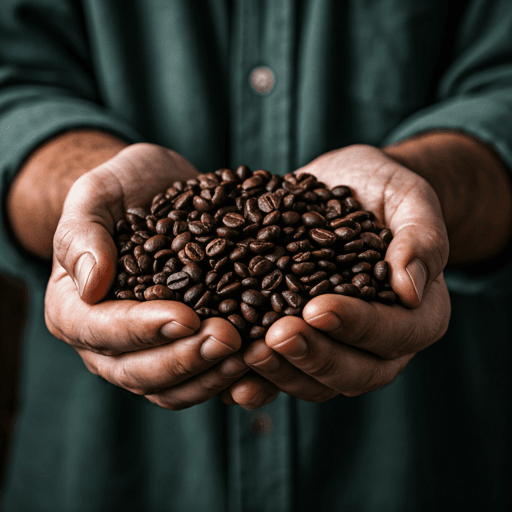
Indian coffee is coffee grown in the shaded hill country of southern India — mostly arabica and robusta from a handful of high, misty growing regions along the Western and Eastern Ghats. It is one of the world's oldest coffee origins, and it is best known for two things: the mellow, low-acid Monsooned Malabar, whose green beans are deliberately weathered by monsoon winds, and the milky, chicory-blended South Indian filter coffee tradition known as "kaapi." Almost all of it is grown in the shade, beneath a canopy of taller trees, which lends many Indian coffees their soft, rounded, low-acid character.
What Is Indian Coffee?
Indian coffee is grown across a belt of tropical hills in the south of the country, at altitudes that typically run from around 700 to 1,600 metres (roughly 2,300 to 5,200 feet). India grows both of the world's main coffee species — arabica, prized for its aromatic, sweeter cup, and robusta, valued for its body, strength and higher caffeine. What makes Indian coffee distinctive is that nearly all of it is shade-grown, cultivated under a two-tier canopy of native and fruit trees, often intercropped with pepper, cardamom and other spices. That shaded, biodiverse growing style slows the cherries as they ripen and tends to produce a cup that is smooth and mellow rather than sharply acidic.
As a growing origin, India sits alongside the great coffee lands of the world. If you have read our guide to Ethiopian coffee, you can think of India the same way: a distinct place with its own regions, varieties and signature processing methods that shape how the coffee tastes in the cup. Just as Colombian coffee has its own recognisable character, India's is defined above all by shade-growing and the monsoon.
A Short History: One of the World's Oldest Coffee Origins
Coffee reached India centuries ago, which is why it counts among the oldest coffee-growing origins outside the Arab world and Africa. The most-told story is the legend of Baba Budan, a 17th-century Sufi holy man. As the tale goes, on his return journey from Mecca he passed through the Yemeni port of Mocha and carried away seven raw coffee beans, bound to his body. Seven is a sacred number in Islam, so smuggling exactly seven was framed as a devotional act rather than simple theft — at the time the Arab world guarded its coffee trade closely and exported only roasted or boiled beans that could not be planted.
According to the legend, Baba Budan planted those seven seeds in the hills of Chikmagalur in what is now the state of Karnataka. Those hills are named the Baba Budangiri range in his honour, and they remain one of India's premier coffee districts to this day. Whatever the exact facts behind the legend, it captures a real truth: Indian coffee culture is old, and it grew up around the southern hills long before coffee became a global commodity.
The Growing Regions
Almost all Indian coffee comes from the south, concentrated in three states — Karnataka, Kerala and Tamil Nadu — with newer, celebrated arabica now emerging from the Eastern Ghats in Andhra Pradesh and Odisha. Karnataka alone accounts for the large majority of the country's output, and robusta makes up a bigger share of total Indian production than arabica. Here is how the main regions break down.
| Region | State | Known for |
|---|---|---|
| Coorg (Kodagu) | Karnataka | India's largest coffee district; both arabica and robusta; balanced, gently fruity cups |
| Chikmagalur / Baba Budangiri | Karnataka | The legendary birthplace; high-altitude arabica with notes of spice and chocolate |
| Wayanad | Kerala | Warm, lower hills; predominantly robusta with a strong, full body |
| Nilgiris | Tamil Nadu | The "Blue Mountains"; brisk, aromatic arabica and robusta |
| Araku Valley & Koraput | Andhra Pradesh & Odisha | Newer tribal-grown Eastern Ghats arabica; clean, sweet, high-grown specialty |
The Karnataka regions are the historic heart. Coorg, also called Kodagu, is the single largest producing district and grows both species; Chikmagalur carries the Baba Budan legend and pushes up to higher, cooler slopes that mature the cherries slowly. In Kerala, Wayanad is warmer and lower and leans heavily to robusta. In Tamil Nadu, the Nilgiris — literally the "Blue Mountains" — give brisk, aromatic coffees.
Koraput and Araku: India's newer specialty arabica
The most exciting recent story is in the Eastern Ghats, where the neighbouring Araku Valley (Andhra Pradesh) and Koraput district (Odisha) have become known for high-grown, tribal-farmed arabica. Koraput coffee is largely cultivated by Adivasi (Indigenous) communities on forested hill slopes, often organically and under shade, and the region has won a growing reputation for clean, sweet, well-structured specialty cups. It is a good example of how Indian coffee is evolving beyond commodity robusta toward distinctive single origins — a subject we cover in depth in our Koraput single-origin coffee guide.
Arabica, Robusta and Shade-Grown Character
Indian coffee beans come in both major species, and the split matters for flavour. Arabica gives the more aromatic, nuanced, gently acidic cup and grows best at higher, cooler altitudes such as upper Chikmagalur, the Nilgiris and Araku. Robusta — which India grows a great deal of, and grows well — brings a heavier body, stronger bitterness and roughly double the caffeine, and it thrives in the warmer, lower belts like much of Wayanad and parts of Coorg. Robusta accounts for the larger share of India's total output.
India also grows coffee under both the wet ("washed") and dry ("natural") methods, and estates commonly produce named grades. The country's shaded, spice-intercropped estates are part of why Indian coffee beans are often described as full-bodied, low in acidity and easy-drinking — qualities that also make Indian robusta a sought-after component in espresso blends worldwide, where it lends body and a thick crema.
Monsooned Malabar: India's Signature Process
Monsooned Malabar coffee is the most famous thing India does to a coffee bean, and it is a genuinely unusual process. The name comes from the Malabar coast on India's southwest edge, and "monsooned" describes what happens to the beans there. During the southwest monsoon, roughly June through September, dried natural coffee beans are spread in layers inside well-ventilated warehouses and deliberately exposed to the moisture-laden winds blowing in off the Arabian Sea.
Over about 12 to 16 weeks, the beans absorb humidity in stages, swelling to nearly twice their original size and fading from green to a pale gold or light-brown colour. Workers rake, re-bag and re-bulk them repeatedly so the moisture takes evenly. The result is a coffee with very low acidity, a heavy, almost syrupy body and mellow, earthy notes often described as chocolatey, nutty and spiced.
The process has a historical logic. In the age of sailing ships, green coffee spent months crossing the ocean from India to Europe in damp wooden holds, and it arrived softened and mellowed. When faster, drier shipping later produced a "fresher" but sharper coffee, some buyers missed the old mellow character — so producers on the Malabar coast learned to recreate those sea-voyage conditions on land. For the estate-level detail and how to brew it, see our dedicated Monsooned Malabar coffee guide.
How Indian Coffee Is Traditionally Enjoyed
In its home regions, the best-known way Indian coffee is drunk is South Indian filter coffee, popularly called "kaapi." It is made by dripping hot water slowly through finely ground coffee — usually a robusta-and-arabica blend, very often cut with roasted chicory — in a small two-chamber metal filter to make a strong, dark decoction. That decoction is then mixed with hot milk and sugar and pulled back and forth between a metal tumbler and a wide-lipped bowl (the dabarah) to froth and cool it. The chicory adds a dark, slightly bittersweet depth and stretches the coffee, and the frothing gives kaapi its signature creamy top.
This is a whole tradition of its own, and we give it a full walkthrough in our guide to South Indian filter coffee (kaapi). Alongside this milky filter style, India also has a fast-growing café and specialty-coffee scene, with local roasters increasingly showcasing single-origin arabica from regions like Chikmagalur, the Nilgiris and Araku as pour-overs and espresso.
Indian Coffee at a Glance
| Feature | Detail |
|---|---|
| Where it's grown | Southern India: Karnataka, Kerala, Tamil Nadu; newer arabica in Araku (Andhra Pradesh) and Koraput (Odisha) |
| Species | Both arabica and robusta; robusta is the larger share of national output |
| Growing style | Almost entirely shade-grown, often intercropped with pepper and spices |
| Signature process | Monsooned Malabar — beans weathered by monsoon winds for 12–16 weeks |
| Typical cup | Full-bodied, low-acid, smooth; earthy and mellow in monsooned lots, cleaner and sweeter in high-grown arabica |
| Traditional serve | South Indian filter coffee ("kaapi") with chicory and hot milk |
The Bottom Line
Indian coffee rewards a little curiosity. It is an ancient origin with a legend at its root, a landscape of shaded southern hills, and a signature process — Monsooned Malabar — that exists almost nowhere else. Whether you meet it as a mellow, earthy monsooned lot, a clean high-grown Koraput arabica or a frothy glass of filter kaapi, it offers a genuinely different flavour of the coffee world. If you enjoyed this, wander through our other origin guides and keep exploring where your cup comes from.