
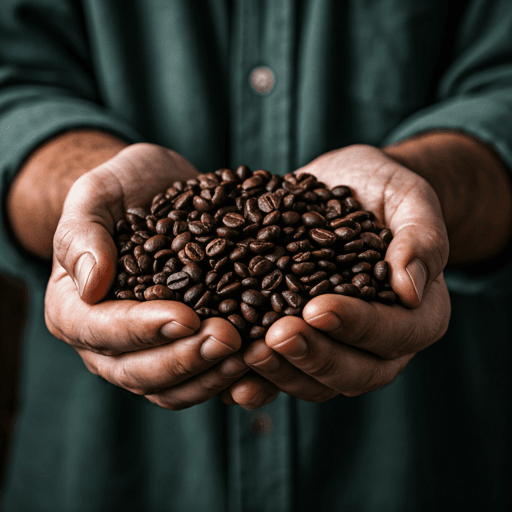
The ethiosar coffee variety is a modern hybrid whose name is also its recipe: "Ethio" for a wild-origin East African parent, "Sar" for a Sarchimor-type parent bred for disease resistance. The idea is to marry the cup of genetically distant material with the field reliability of a rust-resistant line. That is the promise. The documented record behind it is thinner than the name suggests, and this page separates the two.
Ethiosar circulates in specialty trade as an F1 hybrid, but it does not appear in World Coffee Research's public varieties catalog, and no releasing institution, registration or release year has been published for it. What exists is a consistent producer account, repeated by the roasters who buy it, plus a small number of competition appearances. Treat everything below as a category explained well and a specific plant described honestly, not as a datasheet.
What the ethiosar coffee variety actually is
Producer and roaster-facing sources describe Ethiosar as a multi-step cross: Rume Sudan crossed with a Sarchimor, and that offspring then crossed again with Villa Sarchi. The Mierisch family, at Finca Limoncillo in Nicaragua's Matagalpa region, is the group most consistently associated with the plant, and Ricardo Mierisch is credited with the original observation. The story told is that he noticed a single plant thriving at a low-elevation farm, around 800 meters, where neighboring plants were declining under disease pressure and changing rainfall.
Every element of that account comes from the same small cluster of sources, and they largely repeat one another. There is no published breeding record, no trial data, and no independent genetic verification in the public domain that we could locate. That is not an accusation. Plenty of good coffee plants begin as a farm observation and get formalized later. But it does mean "Ethiosar" functions today more as a name for a group of related material moving within a handful of programs than as a formally released cultivar with a defined, registered pedigree. Where you see it stated with confidence elsewhere, that confidence is usually borrowed rather than sourced.
What the name encodes, and the wrinkle inside it
Read as a formula, the name is genuinely useful. "Ethio" stands for the wild-origin, genetically distant parent that is expected to supply flavor complexity. "Sar" stands for Sarchimor, the family of crosses between Villa Sarchi and the Timor Hybrid that supplies leaf rust resistance and yield. Put them together and you have the whole modern breeding strategy in eight letters: take quality from one side, resilience from the other, and hope the first generation gets both.
Here is the wrinkle. The "Ethio" parent is almost always given as Rume Sudan, and Rume Sudan is not, strictly speaking, Ethiopian. It is documented as having been collected around 1941 on the Boma Plateau, in what is now South Sudan, close to the Ethiopian border, by researchers surveying wild arabica populations outside the species' usual center of diversity. Much of the trade calls it "an Ethiopian heirloom" anyway, and that habit is the most plausible explanation for how the "Ethio" prefix ended up on the name. It is a small thing, but it is a fair warning about the rest: a name that encodes a story is not the same as a name that encodes a verified fact. For the background on what wild and landrace East African material actually is, and why breeders keep returning to it, see our explainer on heirloom coffee.
The "Sar" side is far better documented. Sarchimors descend from Villa Sarchi crossed with the Timor Hybrid, the natural arabica-robusta cross that carries most of the rust resistance in modern arabica breeding. The best-known example, Marsellesa, was developed by CIRAD and ECOM and released in 2009, and World Coffee Research rates its leaf rust resistance as intermediate rather than absolute. That distinction matters for Ethiosar too, and we come back to it below.
Why "F1 hybrid" is a technical term, not a compliment
An F1 is the first filial generation: the direct offspring of two genetically distant parents. Cross two dissimilar coffee lines and the first generation often outperforms both, with more vigorous growth, heavier bearing and faster establishment. That effect is heterosis, or hybrid vigor, and it is the entire reason breeders chase F1s. Centroamericano, one of the first commercially released arabica F1s, covers the vigor mechanism in detail and is worth reading alongside this page for a reason that becomes obvious in a moment.
The catch is that hybrid vigor is a one-generation gift. Plant seed from an F1 and the second generation segregates: parental traits reshuffle, and you get a mixed field, some plants good, most not, none reliably like the original. So a true F1 cannot be maintained by seed. It has to be cloned, through rooted cuttings, tissue culture, or somatic embryogenesis in a laboratory, which makes plantlets slower to produce, harder to distribute and far more capital-intensive to establish than handing a grower a bag of seed. That single constraint has done more to slow F1 adoption than any agronomic factor.
Notice what that implies for Ethiosar. Centroamericano's published parentage is T5296, a Sarchimor, crossed with Rume Sudan, which is the same parent pairing the trade attributes to Ethiosar. But Ethiosar is additionally described as having been crossed or backcrossed a second time with Villa Sarchi, and as having been multiplied and expanded on working farms rather than through a clonal nursery pipeline. A backcrossed, farm-propagated, farm-selected line is not an F1 in the strict sense, however it is labeled on a bag. Sources conflict here and no public document resolves it. If a coffee is offered to you as an Ethiosar F1, it is worth asking whether the seller means the technical thing or the marketing thing.
The exception that shows how hard this problem is: Starmaya, from CIRAD and ECOM, is generally described as the first arabica F1 that can be reproduced by seed, because one parent is male-sterile, so every seed it sets is necessarily a hybrid. That workaround took years to engineer and remains rare. It is a fair measure against which any casual F1 claim should be read.
Ethiosar at a glance
| Attribute | What is reported | Status of the claim |
|---|---|---|
| Reported parentage | (Rume Sudan × Sarchimor) crossed again with Villa Sarchi | Consistent across trade sources; no published breeding record |
| Species and group | Coffea arabica, Timor Hybrid introgression arriving via the Sarchimor side | Follows from the reported parentage |
| Origin of selection | Matagalpa region, Nicaragua; associated with the Mierisch family and Finca Limoncillo | Producer account, widely repeated |
| Release year and institution | None published | Not documented; do not assume one exists |
| Catalog status | No entry in the World Coffee Research varieties catalog | Verifiable absence |
| Stature | Compact, consistent with Villa Sarchi and Sarchimor ancestry | Inferred from lineage, not publicly measured |
| Altitude | Said to perform where most specialty arabica struggles; the identification plant is described as growing around 800 meters | Producer claim; the central selling point |
| Leaf rust | Described as resistant, via Timor Hybrid genes in the Sarchimor line | Plausible by lineage; no independent trial data, and resistance is never permanent |
| Yield | Reported above Caturra at lower planting density | Single-source producer claim; no independent trial, figures not repeated here |
| Propagation | Expanded on-farm; not documented as a clonal program | Sits awkwardly with the F1 label |
| Where planted | Nicaragua chiefly, with associated farms in Honduras; scattered lots elsewhere | Small scale; not widely planted |
In the field: what growers actually report
The claim that carries the most weight, and the one that explains why a farm would bother, is low-elevation performance. Most of specialty's celebrated arabicas want altitude: slow ripening, cool nights, dense beans. A plant that yields a cup worth selling at elevations where Caturra struggles is commercially interesting in a way that another high-grown Bourbon selection is not. Roaster-facing accounts put the identification plant at roughly 800 meters and describe that as a workable floor rather than a compromise. No independent trial confirms it, and elevation interacts with latitude, shade and rainfall, so a figure from one Nicaraguan hillside does not transfer cleanly anywhere else.
The second claim is productivity: more fruit per tree than Caturra, at wider spacing, with correspondingly lower input demand per unit of output. Specific percentages and plant-per-hectare numbers do circulate, and they trace back to the producing side rather than to any trial. We are not repeating them, because a yield figure with no independent trial behind it is a marketing number wearing a lab coat.
On disease, be precise. Sarchimor lineage means Timor Hybrid genes, and Timor Hybrid genes mean real leaf rust resistance. That part is sound. But rust carries dozens of known races and keeps generating new ones, and resistance built on a narrow genetic base has broken down before, repeatedly, in varieties that looked bulletproof for a decade. Marsellesa, the best-characterized Sarchimor, is rated as intermediate rather than fully resistant. "Rust-resistant" for Ethiosar should therefore be read as a lineage expectation with an expiry date nobody can predict, not as a permanent property of the plant. Nothing appears to be published on its behavior against coffee berry disease, nematodes or coffee berry borer, and absence of reports is not evidence of resistance.
What Ethiosar tastes like, honestly
Roasters who have bought it describe a chocolatey, sweet cup with moderate rather than piercing acidity and a clean, lingering finish: a well-built, structured coffee rather than a floral fireworks display. Lots have appeared across washed, honey and natural processing, with the natural and honey versions drawing the usual darker-fruit and dried-fruit descriptors. The lot that first drew wide attention to the name was an anaerobic, low-temperature fermented Ethiosar from Los Placeres, a Nicaraguan farm distinct from the family most associated with the variety, which took first place in a Nicaraguan national auction.
Two cautions follow. First, a competition lot from a strong farm with an experimental ferment tells you about the farm and the processing at least as much as about the plant. Second, the sample size is small. There is no broad, multi-region cupping record for Ethiosar, so any confident statement about "the Ethiosar profile" is extrapolating from a handful of lots grown in one region by a small number of farms. Expect sweetness and structure; do not expect it to taste like the wild-origin half of its name.
Ethiosar compared with the documented hybrids
| Point of comparison | Ethiosar | Centroamericano | Starmaya | Marsellesa |
|---|---|---|---|---|
| Type | Farm-selected hybrid line, marketed as an F1 | True F1 hybrid | True F1 hybrid | Pure-line Sarchimor selection |
| Wild-origin parent | Rume Sudan (reported) | Rume Sudan | A male-sterile wild-origin Ethiopian plant | None; both parents cultivated lines |
| Resistant parent | Sarchimor, plus a further Villa Sarchi cross | T5296 (Sarchimor) | Marsellesa | Timor Hybrid 832/2 × Villa Sarchi |
| Propagation | On-farm; not a documented clonal program | Clonal | Seed, enabled by male sterility | Seed; breeds true |
| Developed by | Not published; associated with one producing family | Institutional breeding partnership | CIRAD and ECOM | CIRAD and ECOM |
| Public documentation | Thin | Well documented | Well documented | Well documented |
Read down that first column and the picture is clear enough. Ethiosar is the least documented plant in its own peer group, and it shares a parent concept with a variety that has a full published record. That is a reason for curiosity rather than dismissal, but it is also a reason to describe it carefully and to resist filling the gaps with confident invention.
A variety name on a bag is not a quality grade
This is true of every variety and doubly true of a scarce one. "Ethiosar" on a label tells you what the farm believes it planted. It does not tell you the elevation, the picking selectivity, the ferment, the drying, the storage or the roast, all of which move the cup more than genetics do in most lots. Nor does the name carry any verification mechanism: no registry lists Ethiosar, so nobody is checking whether two bags bearing the name contain the same plant. Rare-variety names get applied loosely across the trade, and a name with no catalog entry behind it is especially easy to apply loosely.
The useful move is to treat the name as a question rather than an answer. Ask who grew it, where, at what elevation, and how it was processed. A roaster who can answer those has a real coffee behind the label. A roaster who can only offer the variety name is offering you the story.
The bottom line
Ethiosar is a genuinely interesting piece of plant material: a wild-origin East African parent crossed into a rust-resistant Sarchimor line, selected on Nicaraguan farms for its ability to perform where altitude does not do the work for you, and planted at modest scale in Nicaragua and on associated farms in Honduras. The name is an unusually honest label for the strategy behind almost all modern coffee breeding, which is exactly why it is worth understanding.
What it is not, on the public record, is a documented cultivar. There is no published release, no named breeding institution, no catalog entry, no independent trial, and a real unresolved question about whether the plant sold under the name is an F1 in the technical sense or a backcrossed farm selection that inherited the term. Anyone telling you otherwise is filling gaps with confidence. If you see it on a menu, drink it for the cup and the curiosity, and hold the pedigree loosely. That is the accurate position, and it will stay accurate until somebody publishes the work.