
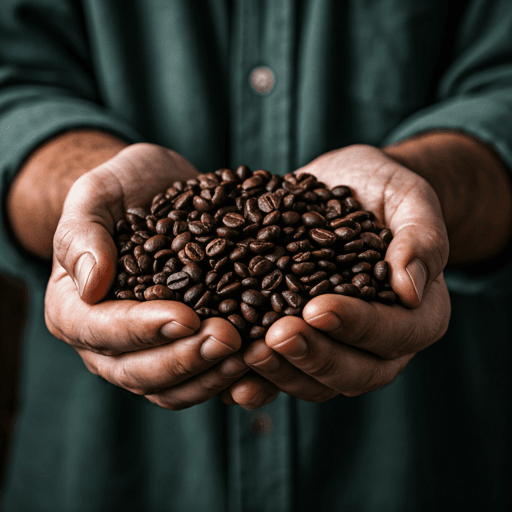
The cuscatleco coffee variety is a rust-resistant arabica cultivar selected and released in El Salvador from Sarchimor material — specifically the T-5296 population — and named after Cuzcatlan, the pre-colonial name for the territory and the root of the demonym Salvadorans use for themselves. It is compact, aimed squarely at low and medium elevations, and carries partial resistance to coffee leaf rust inherited from Timor Hybrid ancestry.
The plant description, though, is the smaller half of the story. Cuscatleco matters because of what happened to El Salvador's coffee sector across the 2012 and 2013 harvests, when leaf rust swept a landscape planted overwhelmingly to Bourbon and Pacas and took a very large share of the crop with it. Cuscatleco was one of the few locally named resistant varieties the country could reach for afterwards. Understanding it means understanding a national replanting problem, not just a cultivar card.
What the cuscatleco coffee variety is, and where it came from
Cuscatleco is a pedigree selection out of T-5296, a Sarchimor population distributed through the Central American research network. Sarchimor is a family name rather than a single plant: it covers descendants of crosses between the compact Villa Sarchi mutation of Bourbon and Timor Hybrid, and the family as a whole is covered on our Sarchimor variety page. Cuscatleco is one national selection out of that population, sitting alongside others taken from the same material elsewhere in the region.
The pedigree usually given is Villa Sarchi 971/10 crossed with Timor Hybrid CIFC 832/2, work carried out at the coffee rust research centre at Oeiras, Portugal. Sources differ sharply on the date. Salvadoran technical accounts commonly report 1959; the World Coffee Research variety catalog dates the relevant CIFC breeding work to 1967, with the T-5296 designation applied afterwards in Costa Rica, generally placed in the early 1970s and usually read as a CATIE accession number from Turrialba. Both dates circulate widely and neither can be dismissed. Treat the parentage as well attested and the year as genuinely contested.
The release is much better documented. The Fundacion Salvadorena para Investigaciones del Cafe, known as PROCAFE, evaluated the material for roughly twelve years at the Ahuacatitan farm in San Marcos, San Salvador, at a little under a thousand metres, and released one line — reported as Line 1 — under the name Cuscatleco in February 2007. That date is traceable to PROCAFE-derived accounts and has been repeated consistently in Salvadoran and trade press since. Where you see "mid-2000s" or an earlier year, it is usually the underlying cross being dated, not the Salvadoran release.
The one thing Cuscatleco is really about: the 2012-13 rust epidemic
El Salvador entered the 2010s with a coffee sector unusually committed to traditional varieties. Bourbon — including the widely planted Tekisic selection — together with Pacas accounted for the large majority of the planted area. That composition produced a distinctive national cup profile and a great deal of justified pride, and it was also, in retrospect, close to a monoculture of susceptible genetics.
When the epidemic broke across Central America in the 2012-13 cycle, El Salvador was the hardest hit of the region's producing countries. Published estimates of the fall vary a great deal depending on which seasons are compared and which agency is reporting, ranging from roughly three-fifths of output lost between consecutive harvests to around seventy percent measured across a longer window. Those figures are revised often and quoted inconsistently, so treat the shape rather than the number as reliable: a collapse of well over half the crop within a few harvests, and a sector that has not returned to its earlier peak since.
What leaf rust actually is, how the fungus spreads, and why weather, shade and nutrition influence outbreaks are all covered on our coffee leaf rust guide. What matters here is the consequence: a country that needed to replant at scale, and needed something to replant with. Cuscatleco was already released, already evaluated on Salvadoran soil for over a decade, and already selected for exactly the elevation band where the epidemic did the most damage. It became, alongside the Catimor-derived Catisic, one of the two locally named resistant varieties that Salvadoran replanting programmes could actually put in a grower's hands.
The replanting has not been quick. Sector assessments years later still describe aging trees, low national yields relative to neighbouring countries, and limited investment in large-scale renovation and grower financing. Labour availability and the three-year wait before a replanted block bears anything are the constraints most often named. Cuscatleco is therefore best understood as a variety with a clear national mandate and an unfinished rollout, not as a variety that quietly took over the country.
The plant in the field
Cuscatleco is a dwarf to compact arabica with short internodes and dense foliage. Salvadoran technical descriptions put mature height at roughly 2.4 metres with a broadly conical canopy and lateral branches reaching around 80 centimetres — a wide, well-filled frame rather than a narrow column. Leaves are large and deep green, and new shoots flush light green rather than bronze, which is the quickest field cue separating it from bronze-tipped introgressed material. Fruit is large, oblong and pointed at the tip, and is described as holding on the branch well through heavy rain rather than dropping.
Bean size is classed as large in the World Coffee Research catalog and cherry-to-green outturn is rated high, which is one of the more practical arguments for the variety: a given weight of cherry yields comparatively well. Ripening is described as average and first production comes in year three. Recommended planting densities of roughly 5,000 to 6,000 plants per hectare under single-stem management follow directly from the compact stature — this is a variety designed for dense, sun-tolerant or lightly shaded systems, not for wide spacing under a heavy canopy.
Elevation is where Cuscatleco was deliberately aimed. Salvadoran recommendations put its useful band at roughly 600 to 1,200 metres, and explicitly suggest it for zones where lifting production with other varieties is difficult. The World Coffee Research catalog gives a latitude-adjusted optimum rather than a single range — higher near the equator, lower further from it — and rates quality potential at higher altitudes as good rather than exceptional. That is a considered positioning. Cuscatleco was bred for the productive middle of the country, not for the top of the hill where the Bourbon and Pacamara reputations were made.
At a glance
| Attribute | Cuscatleco |
|---|---|
| Species / group | Arabica; introgressed, Sarchimor family |
| Parentage | Pedigree selection from T-5296 (Villa Sarchi 971/10 with Timor Hybrid CIFC 832/2) |
| Cross date | Contested — 1959 in Salvadoran accounts, 1967 in the World Coffee Research catalog |
| Selected and released by | PROCAFE, El Salvador |
| Release | February 2007, after roughly twelve years of evaluation at San Marcos |
| Stature | Dwarf to compact; around 2.4 m mature, short internodes, long laterals |
| New-growth tip colour | Light green |
| Bean size | Large; high cherry-to-green outturn |
| Yield potential | Rated medium by World Coffee Research; Salvadoran sources emphasise high productivity for its size |
| Altitude band | Roughly 600-1,200 m in Salvadoran recommendations; latitude-adjusted elsewhere |
| Leaf rust | Intermediate, partial resistance from Timor Hybrid ancestry — not permanent |
| Nematodes | Reported resistant to Meloidogyne exigua; not resistant to Pratylenchus |
| Other diseases | Susceptible to cercospora and American leaf spot (Mycena citricolor) |
| Nutrition demand | High; multiple fertilisations per year are the standard recommendation |
| First harvest | Year three |
| Typical density | Around 5,000-6,000 plants per hectare, single stem |
| Also grown in | Reported in Guatemala and Honduras as well as El Salvador |
How the cuscatleco coffee variety behaves for a grower
The agronomic case is straightforward. It bears from year three, it fills a container efficiently because outturn is high and beans are large, and it holds up in the elevation band where El Salvador has most of its planted area. The root system is repeatedly described as abundant and deep, and the associated tolerance to root-knot nematodes is a real advantage on replanted land where old coffee has been pulled and the soil already carries a nematode population. It is worth noting that the catalogs and the field literature do not fully agree on yield: World Coffee Research rates yield potential as medium, while Salvadoran extension material stresses high productivity. Both are describing the same plant from different baselines.
The costs are equally clear. Nutrition demand is high, and multiple fertilisations a year are assumed in the standard recommendations. A compact variety carrying a heavy fruit load on poor soil will underperform and can exhaust itself, so a Cuscatleco block managed like an old Bourbon block is a block set up to disappoint. Rust resistance also does nothing for cercospora or American leaf spot, both of which remain live problems in humid Salvadoran zones and both of which the variety is described as slightly susceptible to.
Seed source matters more here than with a long-fixed heirloom. T-5296 populations are explicitly noted as not stable from one generation to the next, which is precisely why national programmes selected and released fixed lines out of them rather than distributing the population as-is. Cuscatleco carries more inherent variability than a variety with centuries of self-pollination behind it, so material from a recognised programme is worth more than seed of uncertain origin taken off a neighbouring block.
On the cup, honesty serves better than enthusiasm. Descriptions from El Salvador converge on medium to low acidity, good body, medium sweetness and a balanced, clean profile, with green or herbal notes sometimes reported when the coffee is grown or processed carelessly. That places it in line with how the introgressed families are generally assessed — competent rather than distinguished. Careful processing lifts it noticeably, and some producers have had encouraging results treating Cuscatleco lots with the same attention normally reserved for their heirloom blocks. It is not the variety anyone plants to win a cup competition, and specialty-focused Salvadoran growers still lean on Bourbon, Pacas and Pacamara for that.
How it compares to its nearest relatives
| Trait | Cuscatleco | Villa Sarchi | Catisic |
|---|---|---|---|
| Family | Sarchimor selection (introgressed) | Bourbon mutation (pure arabica) | Catimor selection (introgressed) |
| Leaf rust | Partial, intermediate resistance | Susceptible | Partial resistance |
| Timor Hybrid ancestry | Yes | No | Yes |
| Stature | Compact, around 2.4 m | Very compact dwarf | Compact dwarf |
| Typical positioning | Productive mid-elevation replanting | High-elevation quality, wind-tolerant | Salvadoran resistant alternative |
The instructive comparison is with Villa Sarchi, because Villa Sarchi is one of Cuscatleco's own ancestors. Villa Sarchi is pure arabica, valued at altitude and entirely defenceless against rust. Cuscatleco is its descendant with a fragment of a second species carried into the pedigree, trading a measure of cup distinction for a measure of protection. That trade is the whole logic of the introgressed varieties, and here you can see both ends of it inside a single family tree. The comparison with Catisic is different in kind: same country, same problem, same partial protection, but a Catimor rather than a Sarchimor, which is to say descended from Caturra rather than from Villa Sarchi.
Resistance is borrowed, and it is not permanent
This point deserves to be stated flatly rather than buried in a footnote. Nearly all commercially deployed rust resistance in arabica traces back to the same source, the natural Timor Hybrid, and the fungus has repeatedly evolved to overcome it. Catimor varieties once considered dependably resistant in Central America have lost that standing in the field, and reports of rust appearing on Catimors and Sarchimors in the region have prompted continuing research into how quickly resistance erodes.
Cuscatleco's resistance is classified as intermediate, not absolute, and there is no basis for expecting it to hold indefinitely. A grower planting it is buying time and a better starting position, not immunity. Sanitation, monitoring, shade management and nutrition all still apply, and breeding programmes across the region are actively working on stacking resistance from multiple sources precisely because single-source resistance has a documented history of breaking down.
The bottom line
Cuscatleco is a competent, well-adapted, locally selected Sarchimor that exists because a country lost most of a coffee sector to a fungus and needed something to plant in its place. It is compact, early-bearing, large-beaned, nematode-tolerant, hungry for nutrition, more variable than an heirloom, and honest rather than remarkable in the cup. Judge it against the job it was given — keeping mid-elevation Salvadoran coffee land in production after 2013 — and it does that job well. Judge it against Bourbon at 1,500 metres and you are asking the wrong question of the wrong plant.