
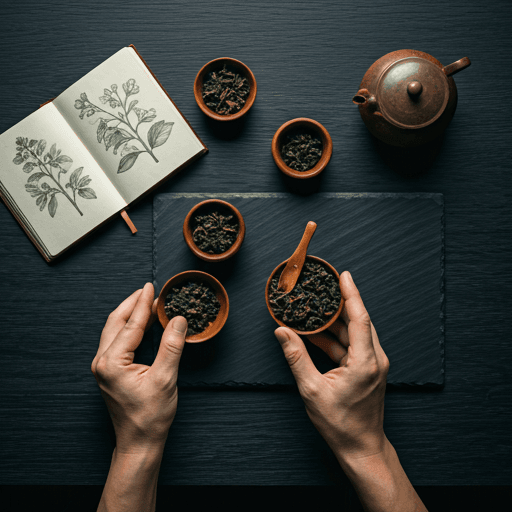
Afghanistan grows no tea. Not a commercial garden, not a smallholding worth counting, not a hillside of bushes anywhere in the country. Every leaf in every glass has crossed a land border on a road. That single fact is why Afghan tea is not one drink but a patchwork, and why what is poured varies noticeably from one part of the country to another.
The short version: the climate and the water rule the plant out, so the leaf is imported overland — and because it is imported overland, the map of what people drink turns out to be a map of where the leaf comes in. None of that comes from soil, altitude or picking season, because there is no crop. It comes from roads.
Does Afghanistan grow tea? No, and the reasons are physical
It is worth being precise about why, because "too dry" is only a third of the answer.
The tea plant is a wet-climate evergreen perennial. It wants moisture spread through the warm months, when it is actually growing and being plucked; humid air that keeps young shoots soft; acidic, free-draining ground; and winters mild enough that an evergreen carrying tender new growth is not repeatedly frozen back. It is not a crop you establish in a season. A garden is a decades-long commitment to the same piece of land, watered every year of its life.
Afghanistan is close to the inverse of that on almost every count. It is a continental, arid to semi-arid country: precipitation is scarce overall and — this is the part that matters most — it is concentrated in winter and early spring, falling largely as snow on the mountains. Standard climate descriptions of the country put the rain and snow in the cold half of the year and leave the warm months, the ones a tea bush would actually use, close to rainless across most of the territory. Water arrives when the plant would be dormant and is gone by the time it would be flushing.
The rest compounds it. Evaporation in a dry continental interior is high and the air is dry for much of the year, so even a well-watered bush would sit in air pulling moisture out of it faster than the roots could replace it. Day-to-night temperature swings are wide by any standard, and winters at altitude are severe — a hard, prolonged freeze is exactly what an evergreen with soft new growth cannot shrug off. Farming here depends on irrigation rather than rainfall: snowmelt-fed rivers, canals, and the traditional underground karez channels that carry mountain water out to fields by gravity. Irrigated land is a small share of the country's surface, and it already carries the grain, orchard and vegetable crops people eat. Arid-zone ground under long irrigation also tends toward the alkaline, with salt accumulation a familiar risk — roughly the opposite of the acidic soil tea prefers.
Only one corner of the country escapes part of this. The eastern mountain fringe catches the outer edge of the South Asian summer monsoon where it pushes up the valleys, which is why those slopes are greener than anywhere else in the country. Even there the summer moisture is modest, the season short, the ground steep and the winters unforgiving. It is the one place where the question is worth asking at all, and it is still not a tea country.
At a glance: what tea needs against what the country has
| What a tea bush needs | What most of the country offers | Consequence |
|---|---|---|
| Moisture through the warm growing months | Precipitation concentrated in winter and early spring, largely as mountain snow | Water arrives while the plant is dormant and is absent when it would be flushing |
| Humid air around the shoot | A dry continental interior with high evaporation for much of the year | Moisture stress persists even where irrigation is available |
| Mild winters, no prolonged hard freeze | Severe winters at altitude and wide day-to-night swings | An evergreen perennial has nowhere to shelter |
| Acidic, free-draining soil | Arid-zone ground that commonly trends alkaline, with salinity a known risk under irrigation | Close to the inverse of the chemistry the plant prefers |
| Reliable water for decades on the same plot | Farming dependent on snowmelt rivers, canals and karez channels | A thirsty perennial would compete directly with food and orchard land |
| Monsoon-touched or maritime terrain | Landlocked and mountainous, with only an eastern fringe seeing summer rain | The single plausible pocket is narrow, steep and hard-wintered |
The contrast with the nearest places tea does grow is instructive, and it is a contrast of geography rather than effort. Tea grows on the humid Caspian strip to the west, in a narrow belt where sea-facing slopes catch moisture the Afghan plateau never sees. It grows on the far side of the eastern ranges, where the monsoon lands properly, and small research and trial plantings sit in the moister uplands closer to the border, on ground that gets summer rain. In every case the deciding factor is warm-season water, and warm-season water is precisely what Afghanistan does not have.
Why Afghan tea follows the road, not the field
This is the part that makes the country unusual, and it is easy to miss because it looks like a taste preference and is not.
In a producing country, regional differences in tea are downstream of regional differences in growing. One valley is higher, another is warmer; one district fixes its leaf green, the next withers and oxidises it. The cup changes because the field changes.
Afghanistan has no field. So regional differences have to come from somewhere else, and where they come from is supply geography. A landlocked country is unusually exposed to this. There is no port and no coastal warehouse, no leaf that simply lands. Effectively every kilo of tea in the country entered across a land frontier and finished its journey by road, through the sea ports of neighbouring countries or overland from the east. Which means the practical question in any given bazaar is not "what would people like?" but "what turns up here, in quantity, without fuss, week after week?"
Answer that question along the long-established overland routes from the east, and the answer has historically been green leaf: the same corridors carried Chinese tea into Central Asia and onto the Iranian plateau for centuries before modern borders existed, and China is still consistently named as the main source of the green leaf reaching the country. Answer it where goods move up from the sea ports of the south and east instead, and black tea features far more heavily; the black tea circulating in this part of the world is commonly described as East African in origin, with Kenya named most often, alongside South and South-East Asian producers. To the north, black tea became the standard cup across parts of Central Asia over the course of the twentieth century as northern trade carried it, while green held its ground in other parts of the same region — which is itself a reminder that supply, not climate, drew those lines.
Then the second mechanism takes over, and it is the important one. A teahouse stocks what it can reliably obtain. A household drinks what the teahouse and the bazaar have. Children grow up on it. Two generations later, that is simply how tea is drunk here — and it stays that way even after the supply picture changes, because by then it is not a preference at all but an inheritance. Habit formed around availability is remarkably durable. What began as a question of freight distance ends up as a regional identity.
One thing should be said plainly: the published record on the regional split is thin, and it does not agree with itself. Green tea, chai sabz, is very widely described as the national default, drunk everywhere and preferred by most people most of the time; black tea, chai siyah, is universally present but usually described as the second cup rather than the first. Beyond that, accounts diverge. Some place black tea more firmly in the north and east and green across the south and west, following the overland corridors; others put black tea in the southern provinces and green everywhere else. Most of these descriptions come from cookbooks, travel writing, diaspora recollection and trade press rather than from any systematic survey, and the larger cities are hybrid in any case — Kabul, Herat and Mazar-i-Sharif are all described as drinking both. Treat the regional split as a soft, broad and commonly reported tendency rather than a line anyone could draw on a map. What is not in doubt is the mechanism underneath it: with no domestic crop, whatever regional pattern exists is set by what arrives and how far it has travelled.
There is a further reason to be careful with confident numbers here. A landlocked country that sits on a transit corridor also moves goods that are not for its own use, and tea is one of them. Recorded imports are therefore a poor proxy for what is actually drunk, and any figure quoted for national tea consumption here should be treated with caution.
How the leaf arrives, and in what form
Loose leaf dominates, sold by weight from sacks and tins in bazaars rather than in bags. The green tea is typically a Chinese-style leaf, often tightly rolled or twisted — the same broad family of manufacture as the rolled pellets covered in our guide to gunpowder green tea. Black tea arriving through the southern and eastern corridors is more often a smaller broken grade, the kind that gives up its strength quickly and stands up to being kept hot for hours.
Brewing is usually done in volume rather than by the cup. A pot — a chainak — or a samovar is set going and kept going, refilled through the day and decanted into flasks in homes and shops so that a glass can be produced for anyone who appears. Cardamom is the most common addition, the pod cracked and the seeds crushed over the tea; cinnamon, cloves or a few strands of saffron appear in some households and for guests. This is flavouring added to brewed tea, not the strong milk-and-spice preparation simmered together with milk that our guide to karak chai covers — the everyday Afghan glass is generally not that drink, although spiced milk chai in the style of the wider region is reported in some eastern and southern cities.
The everyday glass: constant, small, and sweet at the start
Tea is drunk more or less continuously — on arriving somewhere, on concluding anything, alongside food and long after it. It comes in small vessels: slim glasses, commonly called istakan, or small handleless bowls in the Central Asian manner known as piala, with Western-style cups usual in cities. The vessel is small on purpose, because it is going to be refilled repeatedly, and a host who keeps a guest's glass filled is doing the work of hospitality rather than simply serving a drink. Declining is done by gesture as much as by words — covering or turning the glass is the recognised signal that you have had enough.
Sugar does the work that milk does elsewhere. A widely described convention gives a guest a first cup made deliberately, even startlingly sweet — chai shirin — as a mark of welcome, followed by a plain or bitter one, chai talkh. Sugar may also be taken beside the glass rather than in it: a lump of qand held in the mouth so each sip passes over it, or hard rock sugar in winter. Sweets and biscuits are set out for guests — sugar-coated almonds, pistachios or chickpeas, and plain baked kulcha. Milk is generally absent from the everyday glass, appearing mainly at breakfast or on occasions.
Qymaq chai, the occasion tea
The exception to the plain glass is qymaq chai, and it is genuinely an exception rather than a daily habit. It is a richer preparation built on black tea with milk and cardamom and finished with qymaq — a thick clotted cream, the same idea as kaymak elsewhere in the region — floated on top. It is characteristically soft pink to rosy in colour, and it is sweet. It is described as taking real time and attention to make, which is part of why it belongs to weddings and engagements, to celebration breakfasts, and to the moments when a household wants to mark that a visitor matters. Its colour puts it in the same visual family as the pink salt tea found across the wider region, described in our guide to Kashmiri pink chai, though the two are separate drinks with different roles and different seasoning.
The chaikhana
Roadside and bazaar teahouses — chaikhana — are the public face of all this, and they follow the same roads the leaf does. They grew up along trade routes as places where travellers and carriers could stop, eat something simple, drink tea for as long as they liked and often sleep upstairs. That function persists: a raised carpeted platform, a samovar, glasses arriving without being ordered, and a room that works as a shared sitting room for people who have no other reason to be in the same place. Offering tea is the default gesture of welcome in homes and shops alike, and it is not treated as an event; refusing it outright is the unusual act. That broader habit of tea as the opening move of hospitality runs across a wide arc of the region, which our guide to Arabic tea covers in its own setting.
Could tea ever be grown here?
Not at any meaningful scale, and the reasons are physical rather than organisational. You could very likely keep a tea bush alive somewhere in the country — in a sheltered eastern valley, in a pot, under cover — and that is a curiosity, not an industry. A crop requires the water to arrive in the right season, year after year, over ground that suits the plant, on land that is not needed for something else. Here the water arrives in the wrong season, the warm-season air is too dry, the winters at altitude are too cold, irrigated arid-zone ground trends the wrong way chemically, and irrigated land is scarce enough that a slow perennial would be competing directly with food. Irrigation can move water in time and space; it cannot manufacture humidity, and it cannot shorten a winter.
If trial plantings have ever been attempted, they have left no clear trace in the public record, and that absence is itself informative — the agricultural and tea literature records trial plantings in neighbouring uplands, not Afghan ones. The honest position is that nothing documented suggests a planted area of any size, anywhere in the country, at any point.
The bottom line
Afghan tea is a case study in what a tea culture becomes when a country drinks enormously and grows nothing. There is no cup profile to attribute to the place, no harvest calendar and no gardens to visit — but there is a real and unusual structure underneath it, which is that regional drinking differences here are set by trade geography instead of terroir. Green leaf as the everyday default, black alongside it and more prominent wherever the road carrying it is shorter, both in the cities, all of it arriving overland, all of it drunk in small glasses with sugar rather than milk, and one cream-topped occasion tea kept back for the days that count. Where accounts differ on the details, they differ because the documentation is genuinely limited rather than because one of them is simply wrong.